
Seven years ago, Star Wars fans learned that Disney had reached an agreement with George Lucas to purchase Lucasfilm for 4.4 Billion dollars.
Bob Iger, CEO of Disney, wasted no time in announcing their plans to continue the adventures in a galaxy far, far, away with new films.
I would be lying if I said that I was anything but shocked. My initial thoughts were that Mr. Lucas must be ill, and unable to continue working; in actuality, nothing could be further from the truth.
Three years later in December 2015, Disney and Lucasfilm released Episode VII The Force Awakens. It would be the first film in a new trilogy meant to close out the story of the Skywalker family.
As I sat in the nearly empty theater, I was in tears for most of the film, and at the end I was all out balling at the sight of Luke Skywalker, who uttered not a single word!
As time went on, I began to pick apart things that I had seen, and soon discovered from sources within that all was not as it appeared.
Today, I want to take a look back at the direction that Disney and Lucasfilm have taken the sequel trilogy, and what we might expect from Episode IX.
I also want to reveal things that I have learned, as well as sharing my own point of view on this subject. Due to security concerns, the identities and job titles of these sources will not be listed.
They are however they are readily available online, and known to most who keep track of this sort of thing. So, without haste, let us eat a little, drink a lot, and discuss business…
The Force Awakens: Reinventing the wheel
Mark Hamill once stated that J.J. Abrams asked him how he could recapture what George Lucas had done with the original trilogy, to which Mark simply replied “You can’t.”
I learned of this conversation after The Force Awakens was released, and yet it’s gravity was immediately apparent.
I believe that Mark’s reply to Abrams was meant to convey that whatever story that he chose to tell, would have to be of his own doing. There simply is no way to copy someone else’s success.
For months I had read reports that the film was meant to be a soft reboot of sorts to the franchise, with a source close to production at Pinewood stating that very fact.
( Allow me to digress here and state that I am not a fan of reboots of any production. I often wonder why there isn’t anyone capable of writing new stories for films, without re-writing someone else’s work? I mean, shouldn’t that be a form of plagiarism?)
There are to be certain, many parallels between Episode VII and A New Hope. The wide angle shots of Rey on Jakku, the Starkiller base, and the Resistance attack on it are but a few familiar call backs that we see.
Others include The castle on Takadona, which emulates the Mos Eisley Cantina, as well as Rey herself emulating Luke in various scenes. We are also familiar with George Lucas’ vision, as well as his approach to storytelling.
He relied heavily upon Joseph Campbell’s mono myth, and the twelve stages of a hero’s journey to write Star Wars.
Campbell outlined a pattern of writing in which all things were interconnected, and eventually repeated themselves in some way, commonly called the ring structure.
In some ways, I could see the justification for continuing this method by a new writer/director. After all, why try to reinvent the wheel?
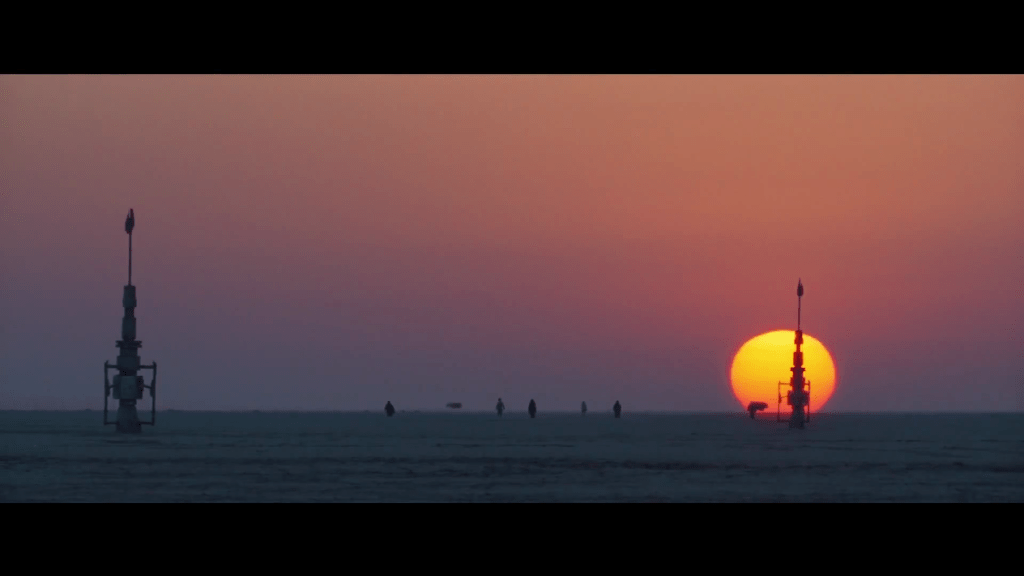
Yet in some ways, I think that is exactly what Disney and Lucasfilm wanted to do with this trilogy, beginning with The Force Awakens.
I think that their intention was to retain elements that were familiar to fans of the original trilogy, while introducing new elements that could more readily be related to by younger viewers.
That intent has both a positive as well as a negative consequence. The positive connotation here is that in addition to the characters and stories that we are already familiar with, new heroes and villains emerge.
With that, we get to experience a whole new chapter in the Star Wars universe. The negative aspect that I see from this is that Disney is using the new characters, films, ext. to establish a new fan base ( and thereby a new base of consumers) from which to market to.
You’re probably thinking right now, “of course they did? How else are they supposed to make money?”
From my isolated perspective, I see the success of The Force Awakens. It excites the fans, they become enamored about Star Wars again.
Maybe they’re like me, and they left the theater for Wal-Mart, looking for a new action figure! In all seriousness, you get my point here.
One of the previously mentioned elements that they used is the protagonist herself, Rey. From the very first moment that we meet her on screen, Rey is somewhat of a mystery.
Where we learn a great deal about Luke early on in A New Hope, we know nothing about Rey four years later!
To complicate the story even more, we have the character of Finn, who in my opinion, is meant to be used as a Red Herring in The Force Awakens, ( and to a lesser degree in The Last Jedi.)
We know nothing about him, either, and are left to wonder throughout the film who the real hero or Jedi actually is. I understand that this was done to conceal Rey’s powers, but at the same time it is a question that still exists today, and remains to be answered.
We see Rey begin a journey, again much like Luke did some forty five years prior, but in a different way. Her path is not as clearly defined as Luke’s.
For example, the Force vision in Maz Kanata’s castle, and her talk with Rey, all point to Rey possibly being Luke’s daughter, as well as a new Jedi. Yet at no time has Disney or Lucasfilm ever acknowledged any of that.
Even today, Lucasfilm will not identify Rey as a Jedi in training, much less a Jedi Knight. So why all of the secrecy? Why allow fans to wane from burn out?
It begs to wonder what type of cinematic storytelling plot is at play here, and what are the fans to expect? Certainly no one expected the conclusion to the final act to not be a conclusion at all, but a cliffhanger.
Least of all, Mark Hamill himself. His only scene was delivering a painful gaze at a young girl. Rather than have some of our questions answered, we have none of them answered, and more are added to them.
I think that if there was any real idea from day one who Rey was or would become, that they used that idea to build upon as they went, rather than following the flow of an established outline.
J.J. Abrams has been quoted as saying that during his initial interview with Kathleen Kennedy, she asked him the question “who is Luke Skywalker?”
The details of that meeting have not been revealed, but certainly that question as vague as it is, seems to have little effect on what we have seen thus far.
After all, Luke Skywalker is just the central character of the Skywalker saga, and forty five years later, shouldn’t he have more to do than stand on a rock gazing at the ocean?
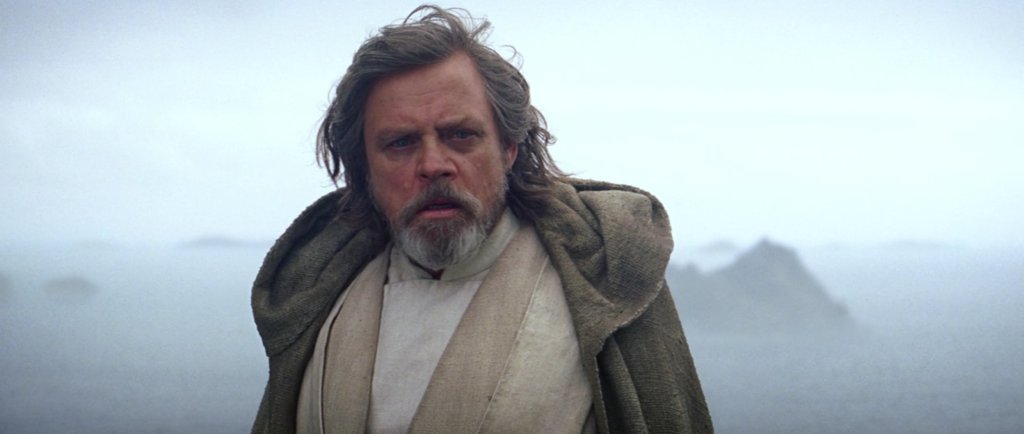
Many critics of George Lucas believe that he too, had no established outline before production began on A New Hope, when in fact the opposite is true.
He had, in essence, a twelve part saga, which he re-wrote into nine parts. So the outline was present, with certain details being changed at various points in the production process.
These changes were made to aide in the plot of the script. (Those for example, who state that Vader was never intended to be Luke’s father, must go back to Obi-Wan’s account of Anakin’s death in A New Hope.)
The Force Awakens was a box office success, but will it be remembered as a great story, or as a re imagining of an unrivaled classic?
I guess that really depends upon your own point of view. Next week in part two, we will examine the lessons learned from The Last Jedi, and it’s impact upon the Skywalker Saga.
 Dark Horizon Creations