The price is wrong

Why the cancellation of Haslab projects in 2026 may be pointing to a downward turn for Hasbro
Introduction

Two weeks ago an announcement was made by Hasbro representative Ben MacCrae that there would be no new Haslab projects for 2026.

I’m certain there were many collectors who were taken aback by the news, while others have posted their relief in the decision.

I am more reserved in my conclusions as to why Hasbro may have made this call, and I don’t think that it is an indicator of anything good for the company.

Before I share my thoughts, let’s look back specifically at Haslab itself, as well as some other business decisions made by Hasbro that fans should be paying attention to.

Scalping the fan base 101

Haslab was founded in 2018 as a direct to consumer crowdfunding platform for premium collectible toys.

It is Hasbro’s solution for making insane stuff that would be cost prohibitive, and high- risk as a mass- retail production item.

They kicked things off with the Star Wars Vintage Collection Jabba’s Sail Barge that same year. The project required eight thousand backers to go into production, with a price tag of five hundred dollars per unit.

Each backer could purchase up to five units each, and many did (Scalpers go a step further, and use the names and emails of other relatives to buy more, in order to flip them for a profit on eBay).

The project closed with exactly eight thousand, eight hundred and ten units ordered, giving Hasbro a total of four point four million dollars in revenue from their first Haslab project.

What they didn’t disclose to consumers Is that each of those units cost Hasbro seventy five dollars to produce, at a total of six hundred and sixty thousand, seven hundred and fifty dollars!

That means that they raked in nearly three point eight million dollars in profits, at a five hundred percent profit over cost margin.

This makes Hasbro the biggest scalpers of the toy industry.
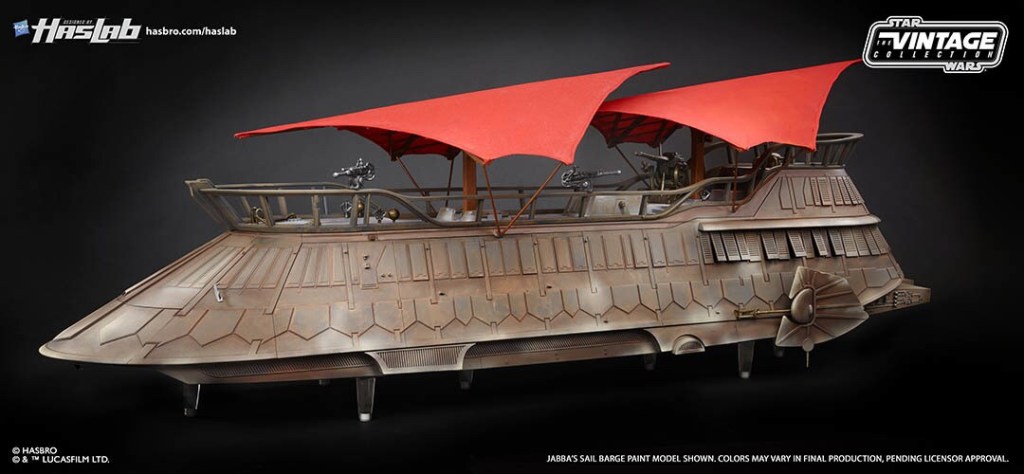
Jabba’s Sail Barge

Hasbro Pulse

So, now that we have had our math lesson for the day with the very first Haslab project, let’s talk about the other side of the coin, Hasbro Pulse.

Pulse is a direct to consumer hub, that is part of their e-commerce website. It is marketed exclusively to adult collectors, who comprise eighty percent of Hasbro’s revenue for their five largest brands.

Star Wars Black Series, Star Wars Vintage Collection, G.I. Joe Classified Series, Marvel Legends, and Transformers Studio Series all feature Pulse exclusives, that are not available through traditional mass retailers.

Both Haslab and Hasbro Pulse are similar in that they eliminate lost revenue, while maximizing profits on sales. They force consumers to buy from them directly, in order to get what they want.

Why it matters

Let’s pause for a moment and take a look at Star Wars as an example. In 2012 Disney acquires Lucasfilm in a four billion dollar deal, that gives the mouse total control over the greatest science fiction franchise of all time.

That control also trickles down to tie-in merchandising like toys. Disney, not George Lucas, now has the final say on what Hasbro gets to do with their new intellectual property.

From 2012 until 2015, Hasbro lost five hundred million dollars in lost revenue on its Star Wars brands alone, which was due primarily to poor sales from The Force Awakens toy line.

This prompted major changes from Hasbro, including the cancellation of the five POA basic assortment of figures in 2019, which were the back bone of the brand since 1977.

It also cancelled the 1/18 scale playsets and vehicles that had previously dominated every Star Wars toy line since the early days at Kenner, up until 2010.

All of these losses were instrumental factors that led to the creation of both Hasbro Pulse, and ultimately Haslab.

Cutting Corners

Now that we’ve taken a look back at some of the factors that led to the creation of Haslab, let’s talk about the here and now.

Hasbro’s current CEO Chris Cocks may become the fault in the company’s foundation. His new “playing to win” strategy is calling for a minimum of three to five percent revenue growth this year.

That strategy included cutting Hasbro’s global staff by twenty percent, or just over eleven hundred positions worldwide.

That may not seem like much for the world’s largest and most profitable toy company, but in reality it may be an indicator of things to come.

Another area that they are cutting costs isn’t just their staff, it’s also in production and assembly of existing toys.

Take for example, the Star Wars Black Series figures. Since 2023 Hasbro has removed points of articulation such as swivel hips, and replaced them with seamless leg joints.

They have transitioned to pinless, single elbow and knee joints, over double elbow and knees with greater range of motion.

By reducing the points of articulation in the line, Hasbro has cut the total cost of production and assembly.

They have also minimized the included accessories with each figure, while capitalizing on their perceived marketing strategy.

The savings to the company then are transferred to the consumer, by giving them a figure with less articulation, and a cost increase to twenty seven dollars and ninety nine cents for a basic figure!

So for the collector, we are paying more while receiving less. Hasbro’s marketing team have done their homework, and they know that collectors will continue to take the bait as long as they give just enough to keep us hooked on the line.

The same holds true for Haslab. When you take projects like the Vintage Collection Cantina, it isn’t as great as it is made out to be.

Rather than being a Haslab project, they could easily have offered that same project as a mass retail or store exclusive.

It could have been marketed in multiple sections, drawing collectors to buy each one in order to build the full Cantina.

So, while some projects may necessitate being offered as a single, large unit, others may benefit from a different marketing strategy.

Haslab Cantina

Haslab’s future

To date, Haslab has funded and produced over a dozen projects, but they have also had at least six that did not receive enough backers to go into production.

Failed projects bring negative publicity, and that’s something that the leadership at Hasbro isn’t likely to allow to continue.

Furthermore, the overall success of Haslab is questionable at best. Support for the projects have declined, particularly in respect to the current economic climate and market.

Collectors are less likely to invest four or five hundred dollars in a project that they have to wait a year to receive, when they can invest that same amount in other toys that are readily available now.

Increased cost of existing lines also hasn’t escaped the attention of collectors, including social media influencers who have exposed it to the public.

When you take all of these factors into consideration, as well as the uncertainty and instability of global markets, it becomes clear that Haslab may be short lived.

Moving on up to the east side

The last thing that I will make note of is this: Hasbro is in the process of relocating its global headquarters from Pawtucket, Rhode Island, to Boston, Massachusetts.

The new facility is considerably smaller, at just two hundred and sixty five thousand square feet, and will house seven hundred employees. It is a very confined location, with an extremely different footprint than its current home.

By comparison, the legacy facility in Rhode Island is a whopping three hundred and forty three thousand square feet. That’s a considerable amount of floor space that the company is giving up.

That in itself is very perplexing from a business standpoint. The reason is this: why would an established company make a high risk move into a multi-million dollar leased facility in another state, when they have an adequate facility that they already own?

If the leadership at Hasbro is so concerned over cutting costs and playing it safe in the current market, then why make this decision?

So, if they are going to such extreme measures to cut costs, then projects like Haslab would certainly be at risk for cancellation.

Conclusion

Haslab was conceived as a means to bring the fans collectible toys that would be deemed cost prohibitive for retail, while eliminating lost revenue, and maximizing profits for the company.

That model is beginning to be seen as a risk in itself, due to decreased interest and negative publicity on failed projects. What is needed then, is a new marketing strategy.

In my opinion, if Haslab is going to continue as a platform, then the answer for its success is a simple one: reduce the cost per unit for the consumer.

Hasbro has made it a point to market the Haslab projects on average at five hundred percent profit over cost per unit.

That isn’t just ensuring zero lost revenue, it is an unethical business practice that has and will continue to have negative consequences.

The issue here isn’t a business model, a supply problem, or shortage of stickers; it’s greed. It is the craving and love of money which corrupts and motivates individuals and companies alike.

The simple fact is Hasbro like any other company is run by people, and not everyone lives a life above reproach. There is a way to make a profit, and do it in a fair and just manner.

That is not unfortunately, what we have seen to date with Haslab, and that may be the very reason why the platform itself fails.

The other possibility and one that I think they should have implemented from day one, is to do the opposite of what they are doing.

Rather than play it safe by limiting these toys to Haslab, would be to market them through select retailers. If you think that wouldn’t work, think again.

The Vintage Collection Razorcrest was almost a Disney Store exclusive, rather than a Haslab project!

The fact is Hasbro has the ability and the means to market these toys however they wish; they simply choose to limit our options in order to maximize their profits.

Incursion: An inside look into a Rebel SpecForces mission.

The extreme height of the forest canopy provided cover from above, while dense undergrowth provided cover on the ground. In fact, the team had been using the extensive micro terrain to their advantage, moving in its shadows all the way to their objective.

They had been dropped off dirtside seventy-two hours prior, being inserted by a sixty at night during a rainstorm.

The mission planners had timed the insertion down to the second, calculating phases of the moons, along with predicted weather patterns to cover their infil.

They used the intense lightning as cover, knowing that it would wreak havoc on the Imperial outposts sensor array.

The pilots in turn jumped in system over the southern pole, and flew below sensor range all the way into the LZ.

They had to mount external drop tanks to the ventral engine pylons just to get the team in and hoped they had enough fuel to make it back to the RV with the fleet.

Two systems away was a Mon Cal cruiser on alert ten, with the QRF and air support ready to go if needed.

Three days of crawling and humping through the forest, and the four-man SpecForces team was nearing their objective.

They had been sent in to take out a Weequay communications specialist who had defected to the Empire. General Madine had given the green light to Captain Maven Therrell, and he picked three of the best shooters in the unit to go along for the ride.

Now, they were nearing the outer perimeter of the Imperial outpost. The facility itself was built into the side of a ridge, with a large plateau to the rear that had been converted into an elevated landing platform.

The armored structure had several turbolaser batteries scattered around the perimeter for air defense, along with ground to air missile batteries.

Outside of the turbolaster batteries was a twenty meter tall ferrocrete armored wall that encapsulated the entire facility.

The team paused, and took a knee behind a fallen tree on the edge of the forest. Captain Therrell signaled for the team to hold, while he moved up to conduct recce.

He used a small pair of macrobinoculars to observe and record the base. He took great care to inspect the guard towers atop the wall, noting that they were spaced every three hundred meters.

He could see Imperial army officers augmented by Stormtrooper patrols, as well as heavy blaster cannons mounted on pintels in each tower.

He also noted the small comlink antennas atop each tower, that would serve as repeater relays for the security element.

Further back at the main complex, he could make out larger aerial antenna arrays pointed up at the sky.

“Blast this” He thought to himself, shaking his head. Captain Therrell moved back to the team and briefed them on what he had observed.

They all knew that the odds were against them before they ever left the briefing for this op, and they volunteered anyway.

“Alright ” Captain Therrell whispered, “switch to our alternate FFP” he stated, referring to their final firing point.

The team slowly moved away from the edge of the forest and selected a route that would allow them to handrail the perimeter of the base from five hundred meters away.

It took them all evening and into the night to make their way around to the back side of the plateau. There, they found a ridge line with a line of sight to the landing pad.

Once they set-up shop, the combat controller extended the large antennas from his backpack mounted ground to air comlink.

He began coordinating with the Alliance Prowler in orbit, setting up the air package for the strike. The other three members of the team set up their Blastech A392R designated marksmen rifles.

Careful not to break noise discipline, they deliberately extended the bipods on the rifles, and moved into prone positions side by side.

They waited and watched all night, until zero three forty five hours when the platform lights switched on at the landing pad.

Then, high up above the team could hear a high pitched whine as a Lambda-Class shuttle dropped out of the sky. The Imperial transport quickly flared, then dropped down onto the pad.

“Stand by” Captain Therrell whispered, “I have control.” The team watched through their rifle scopes as the ramp lowered, and an Imperial security team rushed down the boarding ramp.

They formed a semi-circle at the base of the ramp and then signaled someone the team couldn’t see. Captain Therrell watched as a shadow preceded a short Weequay in black traditional garb, slowly making his way down the ramp.

“Execute, Execute, Execute” Captain Therrell called out. In unison the three SpecForces snipers took the slack out of their triggers, their rifles recoiling from the blast of each round.

Captain Therrell watched as his round raced across the five hundred meters to the landing platform, and split the Weequay’s chest apart with hot plasma. The other rounds hit him as well, sealing the deal.

The Imps immediately reacted, but it was too late. The Alliance shooters were already picking off targets on the landing platform, buying time for the combat controller to their rear.

Suddenly a series of red lances raced down through the cloud bank, striking the Imperial base’ communications and targeting arrays.

The missile batteries came to life, but they were playing catch up. Rebel X-Wings raced by overhead, pummeling each one with micro proton torpedoes and concussion missiles.

As the X-Wings peeled away, the combat controller continued to direct fire onto the base from the orbiting prowler.

The stealth corvette raked the Imperial base with salvo after salvo from its turbo laser batteries, leveling the facility while detonating its power generators.

The SpecForces team remained in position, conducting damage assessment, before being ordered to exfil the area.

As quietly as they had arrived, they stepped away one at a time, back into the forest. As the sun began to rise, the team made their LZ and boarded the sixty for the ride out.

Captain Therrell looked out of the armored viewport, watching the Empire’s science experiment burn to cinders in the morning sun.

What if Jyn Erso survived?

Looking back on Rogue One: A Star Wars Story, I don’t know of too many fans that didn’t want Jyn Erso to survive. Time and time again I have heard how people loved her character, and thought that she was the new hero of the Rebellion.

In fact, you could argue that Rogue One is the most successful Star Wars project to date, since the mouse acquired Lucasfilm. Having said that, there is an entirely different version of the movie that we most likely will never see, and in those edits Jyn Erso does in fact, survive.

This question then, bears relevance for many reasons, and it is one that I began to consider several years ago. It started me on a journey, which resulted in two years of work on the manuscript for a new Star Wars Legends novel entitled Cold Apex.

That novel is now complete and waiting to be approved by Del Rey and Lucasfilm. Though I won’t offer any spoilers on the plot of the book, what I will do is share how Jyn made it off of Scarif. In the third act of Rogue One, we see the Rebel fleet jump in system directly over Scarif, where they begin moving into position to attack the planetary shield gate.

Admiral Raddus, leading the fleet from the Mon Calamari MC-75 frigate Profundity, Orders Blue Squadron to get to the planet. General Merrick then orders the squadron to follow him through the gate, and bringing up the rear are two Incom UT-60D U-Wing gunships.

We clearly see one of them fly through the shield gate before it closes, but what about the other one? Once they fly through and hit the Blue, they begin to provide air cover for the Pathfinders on the beach below. General Merrick then orders the “U-Wings” plural, to reinforce the troops on the beach. He continues by ordering the fighters to follow him and provide air cover for “them,”plural again, referring to the U-Wings.

U-Wing dropping Rebel soldiers on the beaches of Scarif in search of Jyn Erso.

We know that one U-Wing was shot down and destroyed, but where is the other one? In Cold Apex we find the second U-Wing has landed in an outcropping of trees. A small squad of soldiers deploys from the ship, with orders to find Cassian Andor and Jyn Erso. The rebel troops fight their way through the Citadel base, only to find the missing rebels out on the beach.

They are attacked by Imperial troops as the Death Star fires on the planet, with the U-Wing dropping in and saving the squad from certain defeat. With the shield gate down, they make a blind jump into hyperspace while in the skies over Scarif. So, if Jyn survives, what happens to her next?

Well, you’ll have to wait and read the book to find out! I’ve been told that if approved for publishing, the tentative release date will be in late 2026. I’ll share more when I know more from the publisher.

Religion in Rogue One

Introduction

On December 16, 2016 Star Wars fans around the world were introduced to the newest hero within the Star Wars universe, Jyn Erso. Jyn is a battle scarred and complex woman, with a very a traumatic past. She is spartan tough, and stubborn to the core.

Orphaned at age seven, she was forced to watch her mother be executed by Imperial special forces, while her father was taken captive by them as well. Her only hope lay in the man who rescued her, Saw Gerrera. A friend of the family, Saw was Jyn’s only hope of survival, though a hope that would not last.

Throughout her young life Jyn finds herself forced to make decision upon decision which is determined by her alliance with Saw. Though he saves her, he does not give her a normal childhood or freedom. His care for her is minimal, and when it becomes too much of a risk, he too abandons Jyn alone, on a worn torn planet to fend for herself.

At age sixteen, Jyn is once again forced to make decisions in order to survive from one day to the next. When we find her in Rogue One, Jyn is a young woman imprisoned by the Empire in one of their POW camps on the planet Wobani.

She is seemingly rescued by the Rebel Alliance, who have their own agenda for her as well. There is no care for her future or well being; Jyn is simply a means to an end for them. Though she reluctantly agrees to help them, she finds herself in a dream remembering her parents before she is abruptly awaken on a flight into the ancient moon of Jedha.

Jedha is a world of many stories, with some claiming that it was on Jedha that the Jedi first discovered the Force. Jyn ventures into the holy city, and encounters a cultural soup of denizens from across the galaxy, who are adherents of many religions. Though their beliefs and practices may differ, they are all drawn to Jedha for the same reason, and that is the church of the Force.

Its existence is ancient, and its followers are many, but its message is the same: there is only the Force, and it is the Force that draws them there. Jyn being the skeptic that she is, becomes intrigued when Chirrut Imwe is able to sense the Khyber crystal necklace hanging from her neck.

She wants to know more, but time does not allow it. We later see Jyn rubbing the Khyber crystal again on her way to Scarif. This brief insight into the Force is a much more grounded aspect of it’s cultural and religious significance to peoples across the galaxy. We know from Obi-Wan Kenobi that the Force is what gives the Jedi their abilities and powers.

It is an energy field created by all living things; It surrounds us and binds the galaxy together. For those born sensitive to it, it is there, just beyond their grasp. For those like Chirrut Imwe, it is the focus of their religious experience, but not a tangible presence that they harness as the Jedi and Sith do.

For people like Jyn, it is a mystery that fascinates and intrigues. It leads her to a place of inner searching. She finds herself questioning her mother’s bedtime stories about the Force and the Jedi, and she begins to ponder if they were actually true? Her memories are in many ways her only real connection to her mother, and for whatever reason, they seem to be guiding her on her mission for the Rebel Alliance.

What if?

For the past two years I have been working on the manuscript for a Star Wars Legends novel which continues the story of Jyn Erso. In it we find that Jyn who was presumed lost, is clinging to life, and at the center of her journey is the question of religion. Is the Force real? Is it guiding her to her destiny, or is it just her experience, training, and a little luck?

The story explores how Jyn’s personal beliefs reflect the echos of an ancient past, where it was at the heart of whole races and societies. The Force is more than Jedi and Sith, it is the defining religion of a by-gone era. People like Jyn’s mother Lyra who cling to it’s ideals and teachings, are viewed as heretics and traitors to modern governments and societies.

Its origins are erased, its texts are destroyed, and its existence is taught as a myth. Where other religions are accepted or tolerated, the Force becomes a forbidden word across the galaxy, and those who speak of it are hunted down and taken into custody.

What was once at the heart of every civilization in the galaxy, has now become culturally irrelevant and outdated. As the old generations pass on, younger generations grow up in the shadow of its knowledge and presence, knowing nothing of its power and purity. Its mysteries lay hidden in plain sight, waiting for those who are brave enough to seek out answers to life’s questions and troubles in its teachings.

Conclusion

Jyn’s journey becomes one of self discovery, as she is forced to confront her mother’s beliefs, and their impact upon the here and now. We see the reality of religion in the midst of contemporary culture, and the relevance that it offers to those brave enough to search for the truth.

Ultimately the Force and religion aren’t the focus of the story, but they become an aspect of it that Jyn cannot deny, and that she cannot ignore. It is a doorway to be opened, as she seeks for answers in the midst of the chaos of war.