
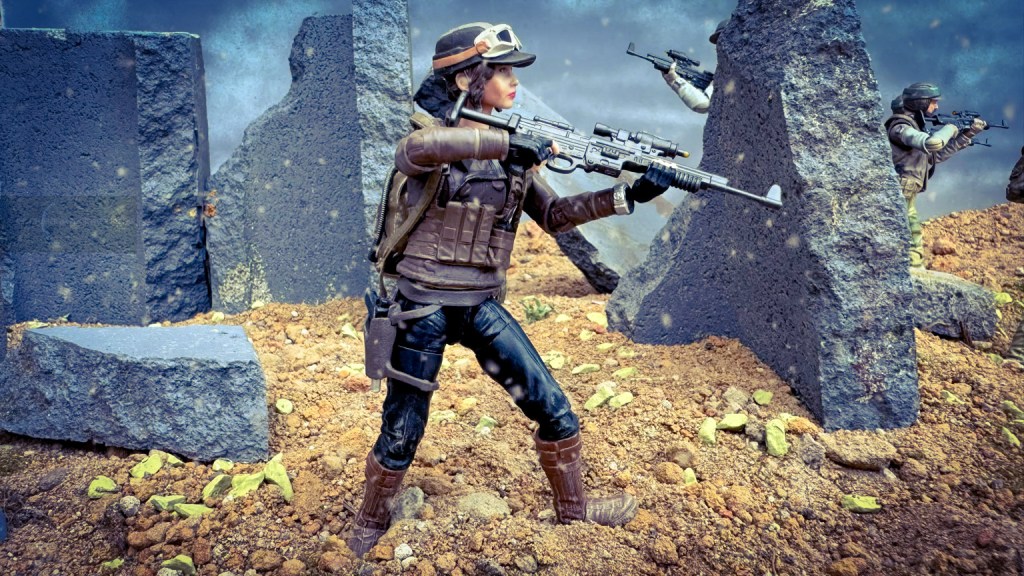
One of the most famous aspects of the Star Wars universe are blasters, the individual small arms carried by just about everyone. Be it a DL-44 blaster pistol in a drop thigh rig, or the iconic Blastech E-11 carbine issued to the Stormtrooper Corps, blasters are everywhere in the galaxy.
In the Original Trilogy, we see the effects of blaster fire as civilians, Imperials, and rebels alike go down instantly when hit with a single shot. The all too familiar sound of blaster fire from Battlefront is still ringing in my ears, and I can smell the ozone in the atmosphere.
So how exactly do these weapons function, and what makes them so lethal that they can drop a person instantaneously with one round? To answer that, we first have to take a look at the inner workings of the blaster itself.
Small Arms Physics
Blasters are not like modern firearms, which utilize propellant ignited from a firing pin or striker in the base of the cartridge to propel a projectile downrange. The only in-universe weapons that use modern fierarms technology are referred to as slug throwers, and the only on screen use of these can be found with the Sandpeople of Tatoonie.
Blasters on the other hand utilize compressed and highly pressurized Tibanna gas that is stored in a detachable magazine or bottle. This is inserted in different locations on different weapons, with some utilizing internal storage, while others combine the gas within a detachable box “magazine” that also houses the power packs.
When the trigger on a blaster is pulled, it does two things simultaneously; it uses a burst of electrical charge from the power pack to an internal laser, which excites the Tibannna gas that is released at the same time. This creates a charged plasma beam, which is focused through a series of rings, and propelled down the chamber where it is encased in a magnetically charged field. This in turn propels down the barrel as a bolt of plasma energy.
This bolt is what you see exiting the weapons, and it is travelling as fast as you see it. Studies done of the on-screen shots place blaster bolts at somewhere between thirteen hundred and fifteen hundred feet per second, so they do not travel as fast as a modern firearm projectile. Individual small arms are also not as loud as a firearm, though they are loud enough.
The power behind these weapons is directly corelated to the type of gas utilized, with Tibanna gas being the most powerful. Some blasters like the Imperial E-11 series were equipped with a lower power stun setting which would incapacitate and render unconscious a target. That is not the case for most military grade weapons such as DMRs, sniper support rifles, heavy blasters, and crew served weapons.

I should also note that during the reign of the Empire, it was illegal for civilians to carry and own blasters which could defeat body armor, but many often did. This includes those who used internal modifications to make weapons more powerful, as well as buying and using military grade arms like the Rebellion did.
Terminal Ballistics
Now that you understand how the weapons work, its time to turn our attention to the fun stuff; terminal ballistics. You’ve seen the blaster bolts, heard the distinctive report, and watched the drug pushers of the Pyke Syndicate as they get dropped on the streets of Mos Espa; So what exactly makes blasters lethal?
First, we need to go back and look at a previous piece of information that I provided, and that is what constitutes a blaster bolt, which is plasma. Bolts of magnetically encased plasma striking any flesh, cause a series of instantaneous and significant damage to living tissue.
The extent of that damage is dependent upon where on the body a person is hit. If an individual is trimmed on the shoulder for instance, they would be badly burned, with the wound instantly cauterizing itself. They would, however not be subjected to the same internal “pop” of the blaster bolt as if it had entered the body cavity.
A direct hit to a person’s center of mass by a high-powered shot would cause surface level burns on the outer and inner tissue, as the bolt passed through the skin and into the body cavity. There, the high pressure from the bolt exploding would cause massive internal boiling and trauma.
Nearby organs would be catastrophically damaged or destroyed, depending upon their proximity to the bolt of plasma when it explodes. There would be massive hemorrhage, but little if any blood loss due to the entry and exit wounds cauterizing from the extreme temperature of the plasma.
Center of mass and upper center of mass shots are always lethal, while lower center of mass hits to the abdomen may be survivable, if the correct medical treatment can be obtained in a timely manner. For this reason It is possible to survive a blaster hit, but it is extremely rare, due to the amount of energy being released inside of the body cavity.
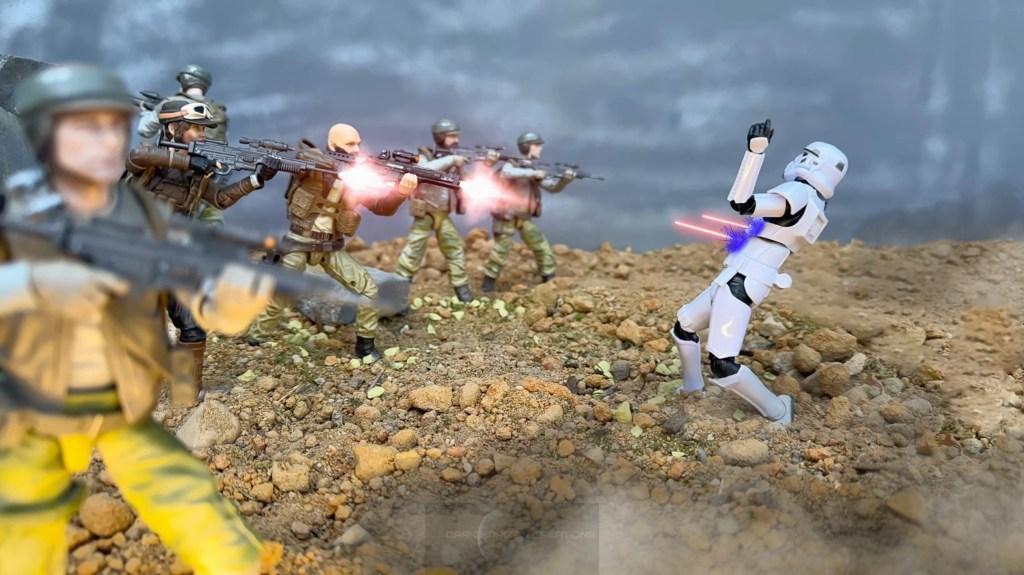
This is why Stormtroopers are issued armor, which is rated to defeat certain weapons. The armor works by dissipating the energy from the blaster bolt and spreading it out across the surface, where the plasma burns away the outer layers.
This is not sufficient for military grade weapons, which is why you have seen Stormtroopers go down when hit by rounds from Han Solo’s DL-44 blaster pistol. This is a highly modified military grade weapon, which accounts for the damage that it inflicts.
Conclusions
So, now that you understand how blasters function, and what makes them lethal, you can begin to appreciate not only the science and technology behind them, but also how cool they are! Everyone wants one, right? I know I do.
 Dark Horizon Creations