
An in-depth discussion of the Action Force narrative
Introduction
I am a huge fan of the Action Force comics and figures produced by Valaverse, so naturally I am fascinated by the story behind it.
Bobby Vala has created a very interesting mythos for these characters, that in many ways has an eerily familiar parallel to modern day events.
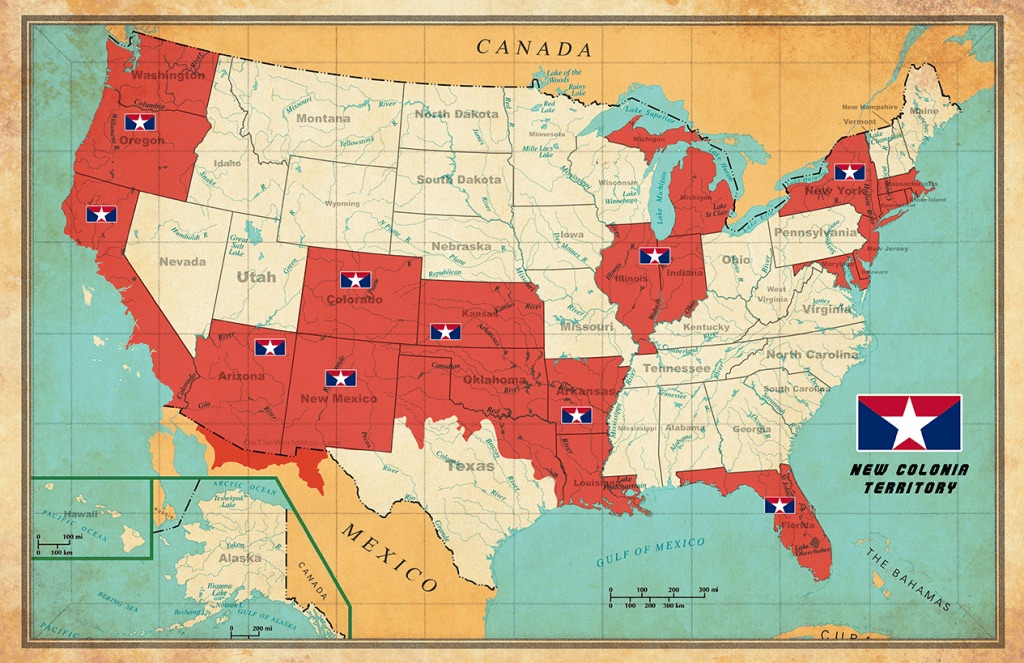
The catalyst for the narrative is an event called “the Divide”, in which the United States of America is dissolved, with each state becoming its own sovereign republic.
In spite of reading the comics from the series, I find myself left with more questions than answers. How exactly did the United States cease to be? What caused it? What happens to the U.S. military, its assets, and infrastructure?
These are just a few of the immediate questions that one would be faced with in such a crisis of this magnitude. So, in this post I am endeavoring to fill in some of the unanswered aspects of the Action Force narrative, that may help casual readers as well as hard core fans to better understand the mythos.
I will preface this by stating that I am not endorsed nor have I received permission from Valaverse to write this post; I’m simply a fan having fun by delving into this exciting universe from my own experience and research.
Catalyst for crisis
In the Action Force mythos, a series of events leads to the dissolution of the United States of America. In its place are fifty independent states. Sovereign and fractured by the Divide, they now stand alone to pick up the pieces. The first question is, could this really occur, and if so, how?
In theory yes, the United States could be dissolved as a Republic, but it would not occur overnight. One possibility would be a series of catastrophic events that occur in succession.
An example would look like this: Economic collapse occurs, followed by riots, violence, natural disasters (like the earthquake of 2028 in the Action Force mythos), and even domestic conflict.
Whatever the events that begin the chain reaction, they must all lead to the same outcome: multiple states become fed up with the state of affairs in the federal government.
From there, two-thirds of the state legislatures could then call for a constitutional convention under Article V.
The only way that the republic could be dissolved then, is that two-thirds vote determines that the dissolution of the union is in the best interests of the American people.
At this point an amendment to dissolve the Union is drafted, and sent to each state for ratification under Article V. If three fourths majority sign it, then it would become accepted as a legally binding document and become law.
At that point on that day, the United States of America would cease to exist as a unified republic of fifty states. This would then require and begin the process of disposition in each state of federal assets and liabilities.
This would include any and all United States military assets and infrastructure within each state. The process would be daunting, as each state would most likely activate their National Guard and use it as a temporary command to carry out this process in a controlled and safe manner.
At the top of this list would be the United States nuclear arsenal. Based on International law, The U.S. could theoretically request international assistance from NATO partners prior to the dissolution, in order to provide time for these weapons to be secured, dismantled, and taken into the custody of allied partners.
They may even assign NATO forces to oversee this at current decommissioning sites stateside. This process would take months, if not years to complete, and would be the most high-risk aspect of the dissolution of the union.
The second and third tiers of responsibility for the states would be Air and naval assets, respectively. By all accounts, the bulk of these would cease to be utilized due to the fact that their operation requires tens of thousands of certified personnel across the country to do so.
Of greatest concern would be the security risk they pose to foreign enemies seeking to take advantage of the fallen union. Internally, there would be an unprecedented amount of chaos and lawlessness in most states.
Disease, hunger, and violent crime would skyrocket. There would food shortages, power outages, uncontrollable reactions from the worst in society. These events would most likely result in localized armed conflicts of themselves.
Local first responders and the national guard would be outnumbered and overwhlemed by the sheer number of incidents. Medical emergencies would overwhelm local emergency rooms, and the death toll would rise.
The world would watch America tear itself apart, while it too felt the effects across the oceans. Without the commanding presence of the United States and its leadership to guide the free world, other nations would also suffer.
There would be untold economic repercussions, while the wild cards like China and Russia would seize the moment for their own agendas.
Wars would ensue that would require the entire free world to band together in a way that they never thought possible. It would be a trying time for everyone.
In the midst of the chaos, some states in the union may seek safety in numbers and propose regional alliances with each other. State governors would undoubtedly seek to maintain stable economic ties, while ensuring continuity of commerce across borders.
Laws would be amended, or at least temporarily so, in order to reflect the state of the fallen Republic.While there may be a conservative effort to restore the Republic, there would most likely be resistance from liberal states and their leaders.
They may enjoy their newfound independence, and begin making laws which benefit the ultra-elite, rather than the common good of everyday citizens. It is from these crevices in society that the greatest threat may emerge.
Leaders from every sector of society banding together in what would formerly be criminal enterprise, sowing discord within, while forming allegiances with external enemies of the former United States of America.
Evil people who would do anything to capitalize on open access to the land of the free, with unrestrained ambition driving their every move. The only way to counter such a threat would be a clandestine and unified military organization on land, derived from former military personnel who could be vetted.
They would have to have a single objective, with unequivocal support. Their missions would be clandestine by necessity and would require unparallel cooperation across state lines.
It would be a daunting task, but not an impossible one. The key to success would be unity and the use of surgical operations aimed at exploiting intelligence.
Months if not years would be required, but there would come a point in the near future where if enough states unified under a single banner, they could reclaim what was lost.
This then, is an extremely hypothetical yet realistic scenario for what we have been made privy to in the Action Force mythos.
Through the use of multiple factions playing different angles, we are being given a glimpse into corruption fully conceived in this nation.
The answer then, is a response as unconventional and unanticipated as the evil that demands we respond to it.
Conclusion
What we see in the Action Force mythos is if anything, an eerie parallel to current global events. This isn’t our favorite action cartoon of yesteryear; it is rather a wake-up call to the reality around us.
If anything, playing with these action figures or reading the comics should motivate us to live lives that are above reproach, abiding by an ethical, legal, and moral code no matter the conditions around us.
It’s time for Action!



 Dark Horizon Creations