My thoughts on the G.I. Joe Classified Series

Introduction

2020 was a very devasting year for many, but there was also good in the midst of the bad. One of those things was the release of the G.I. Joe Classified Series line by Hasbro.

When I first learned about this line in 2019 I was both excited and skeptical about it, having only rumors to go on.

When the figures were first released in June of 2020, the demand exceeded supply, and stores were quickly stripped bare by collectors and scalpers alike.

The Target exclusive Cobra Island sub-line fared no better, with limited inventory, and some stores putting out stock before the street date.

This caused confusion, and led to Hasbro redacting the street date by a week, allowing inventory to be placed out for sale.

What followed was a merciless attempt by scalpers to get their hands on as much inventory as possible, forcing collectors and consumers to turn to eBay as their only source for these figures.

This allowed scalpers to inflate aftermarket prices by as much as five times or more the actual MSRP of the figure, forcing collectors to meet their demands if they wanted to obtain them.

It was and is a serious blight on both the toy industry, and collector community alike.Early on I managed to snag several of the Wave 01 figures from an area Wal-Mart and GameStop twenty miles away, before their inventory disappeared.

I was eager to get the new Target exclusive Beachhead and Cobra Troopers, and began waiting for their release date.

I live in a rural area, so the nearest Target store to me is roughly fifty miles away. My first trip there last year proved to be a nightmare.

They had inventory on hand in the stock room, but the management present was not aware that the street date had been lifted, and because of that they refused to sell me any of the figures.

I would make several more trips over the following months, with nothing to show for it but an empty gas tank.

I finally caved in and purchased two of the Cobra Troopers on eBay for a whopping one hundred dollars each! Thankfully, that would turn out to be the worst experience that I have had with the Classified Series line to date.

Meet our demands, or you’ll never have us in hand!

Overview

The G.I. Joe Classified Series is possibly the most successful line of figures within the franchise, since the debut of the three and three quarter inch scale A Real American Hero line in 1982.

Each of the figures is based on the six inch scale, with each figure being scaled according to their character’s stature in relation to each other.

They boast thirty six points of articulation, and include at minimum one weapon, and at least one accessory, with most having several of each.

The figures also feature updated appearances and uniforms, which are based upon their original A Real American Hero designs from the 1980s.

Most of the weapons are futuristic, and are scaled down replicas of some Nerf blasters. This was done intentionally, to steer the line away from being seen as promoting firearms and violence in play.

This has been a point of debate among adult collectors who grew up as fans of the original G.I. Joe cartoons, comics, and toy line.
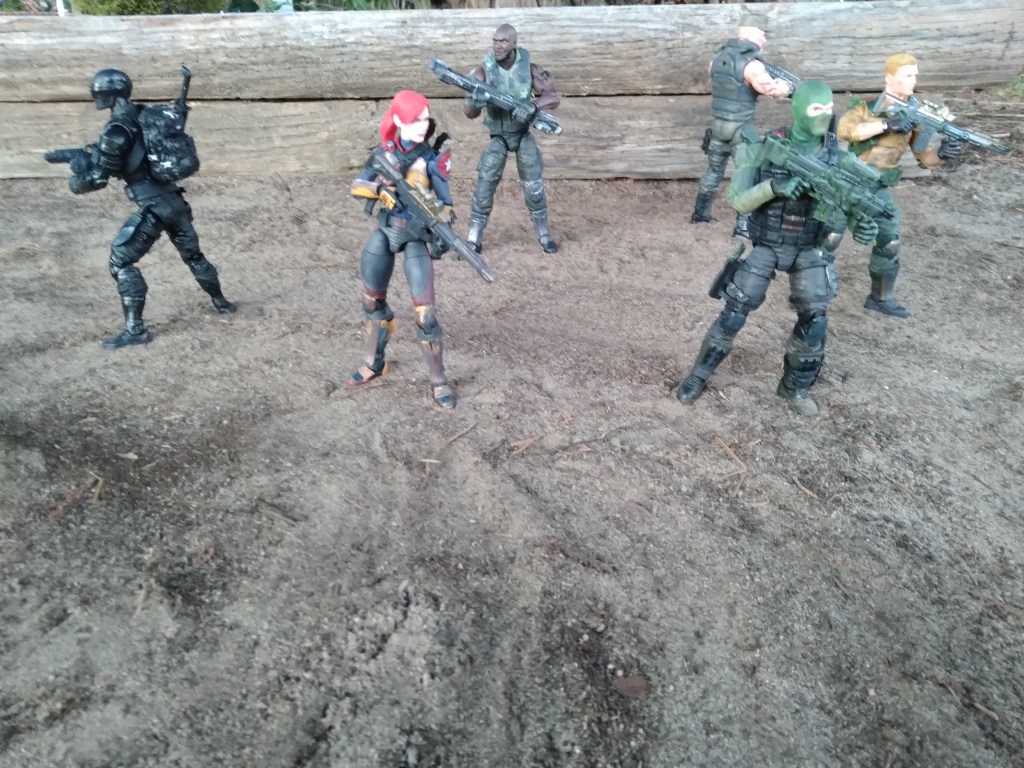
A tight 360 for the camera

The idea is that G.I. Joe has always stood as a symbol of morality, pitching good versus evil on the battlefield.

The individual weapons, aircraft, armor, and boats were all portrayed as implements of war, and each episode of the cartoons and comics depicted G.I. Joe fighting Cobra forces.

The idea that depicting either G.I. Joe or Cobra using actual weapons has any bearing or negative influence over the hearts and minds of today’s youth, simply has no foundation in reality.

The Classified Series figures are not the first G.I. Joe line to be designed in the six inch scale, but they are the first to go into production.

A previous line based loosely on the G.I. Joe Pursuit of Cobra figures was drawn up nearly ten years ago, but never went into production.

It is unknown why that line was cancelled, however it proves that the concept for a six inch line of G.I. Joe figures was seen as a valid direction to take the franchise.

Recently it was revealed in the updated Linkdin profile of Hasbro’s Senior Marketing Director Irvin Ducournau, that he was responsible for the development of a global brand strategy ( G.I. Joe Classified Series ) planned for three to five years.

If that’s true, then that would make the G.I. Joe Classified Series the third longest running line of action figures produced for the brand by Hasbro to date.

And if sales are any indication, it is has quickly become by far the most popular line as well.

My Assessment of the line

One thing that I strive for when I do a toy review is to remain unbiased in my report. I usually spend dozens of hours reviewing a single figure, including their in universe history, their production facts, as well as looking at other reviews.

Ultimately my assessment is based on my personal in hand experience with the toy. That includes addressing quality control issues that have been previously reported by other collectors and consumers, as well as offering my own opinion.

Overall I think that the G.I. Joe Classified Series has exceeded my personal expectations of the line, and it certainly lives up to the hype on social media.

I will say that my primary point of concern is with the weapons being made of soft plastic, as most of them have a tendency to be warped beyond the ability to correct.

If I could offer any suggestions for future waves, it would be to either include two weapons with every figure: a sidearm and a rifle, or to offer a weapons pack as a separate expansion kit that could be purchased at retail.

This would give collectors an additional means of outfitting their figures, and offer an attractive feature that would enhance the collector experience.
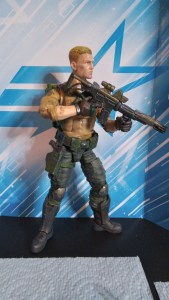
G.I. Joe Classified Series Duke with warped rifle

I think that the design team has done a tremendous job with this line, and so has the marketing team.

Their color choice, design, and layout on the packaging are both eye catching and simplistic. I also like the redesigned character abilities icons on the side panel, as it gives collectors an added feature to their experience with the figure.

I have found that some of the complaints by collectors and consumers are both biased and unfounded.

Conflict among collectors

First, when you are speaking about collectors, you are referring primarily to adult collectors who have been and are life long fans of G.I. Joe.

People collect for a myriad of reasons, but there are some of us who are more versed in this world then others, and can be considered subject matter experts when it comes to toys and toy collecting.

To that end, I want to address this issue:

There are some who use social media to compare the Classified Series with it’s only competitor, Action Force.

Any collector or influencer like myself, is going to offer their opinion when there is a standard to compare something to, but unfortunately that isn’t the case here.

The reason being is that the Action Force line of six inch military style figures has yet to be shipped from the manufacturer, and no one has these figures in hand to compare them to the Classified Series figures.

Action Force? Is that like the girl scouts?

Second, Action Force is a brand new start-up by a former employee of the Hasbro design team. Their target demographic is the adult collector community, whereas the Classified Series is marketed to collectors age four and up.

That means when designing these figures they were incorporating features that would appeal to a much broader consumer base than what Action Force is doing.

You also have to take into consideration that G.I. Joe has been around in one scale or another for the past sixty four years.

Action Force on the other hand is a new line, from a new start-up. The name Action Force originated in 1982 with Palitoy in Great Britain as a response to their failed Action Man line.

The new line was composed of multinational figures, but would soon include their own rebranding of G.I. Joe’s as well.

Once their trademark came up as available, it was purchased by Valaverse, and used to rebrand the Action Force line. The first wave of figures were offered through a kickstart campaign.

The video reviews that have been posted to social media sites like YouTube have mostly been of a biased nature, and used to promote the Action Force brand, while debasing the Classified Series.

With no Action Force figures in hand to actually compare to the Classified Series, these unprofessional reviews are of no merit to the collector and fan communities.

At best they demonstrate the polarizing views associated with individuals who have no regard for professional culture or ethics, and who offer no insight into the product itself.

Conclusions

The G.I. Joe Classified Series has brought new life to an old friend, and renewed interest among fans. It is a modern take on an eighties classic, that we all grew up with and loved.

In many ways it allows us to reconnect with our childhood, and experience emotions and familiarity with a far better time in our world, than the days in which we live.

The Classified Series has in fact, taken G.I. Joe fans by storm, and made our dreams come true. Despite opposition from a few, the G.I Joe Classified Series is here to stay.
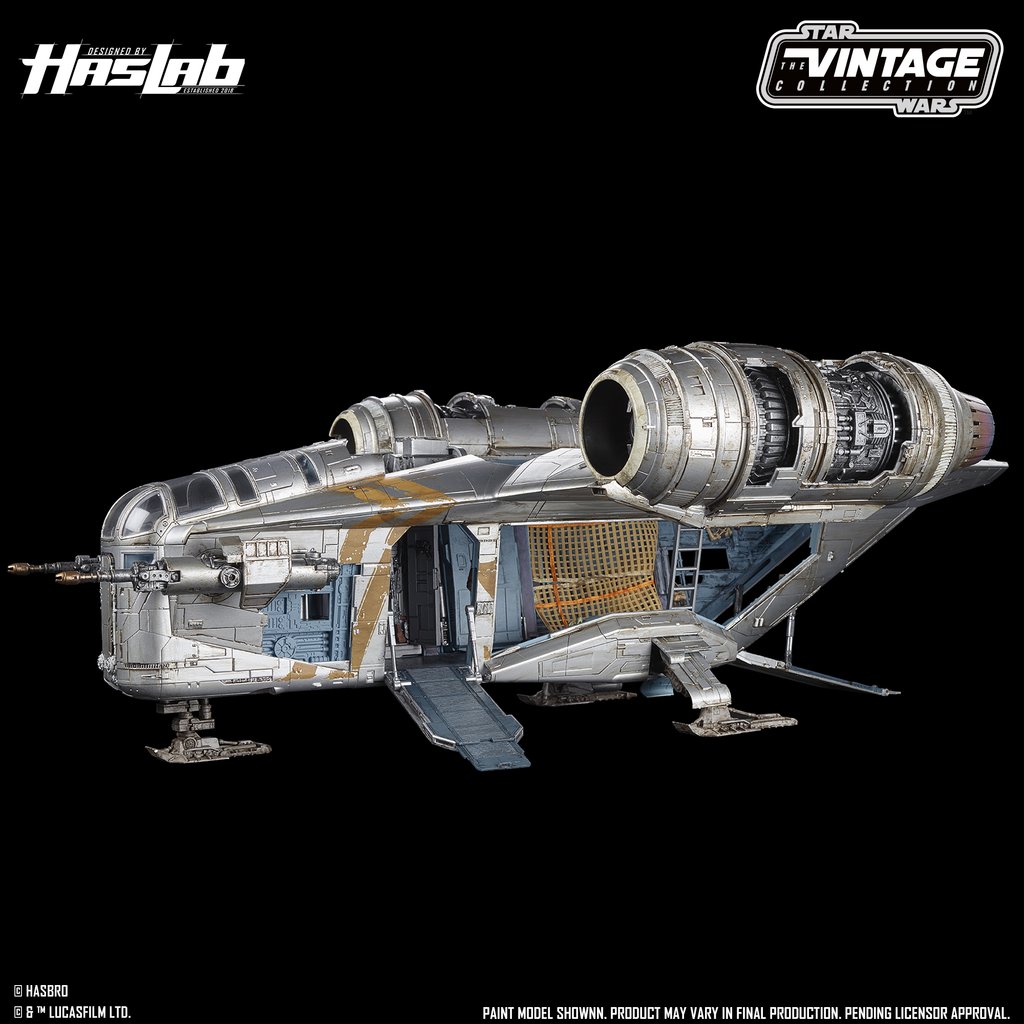
Haslab RazorCrest

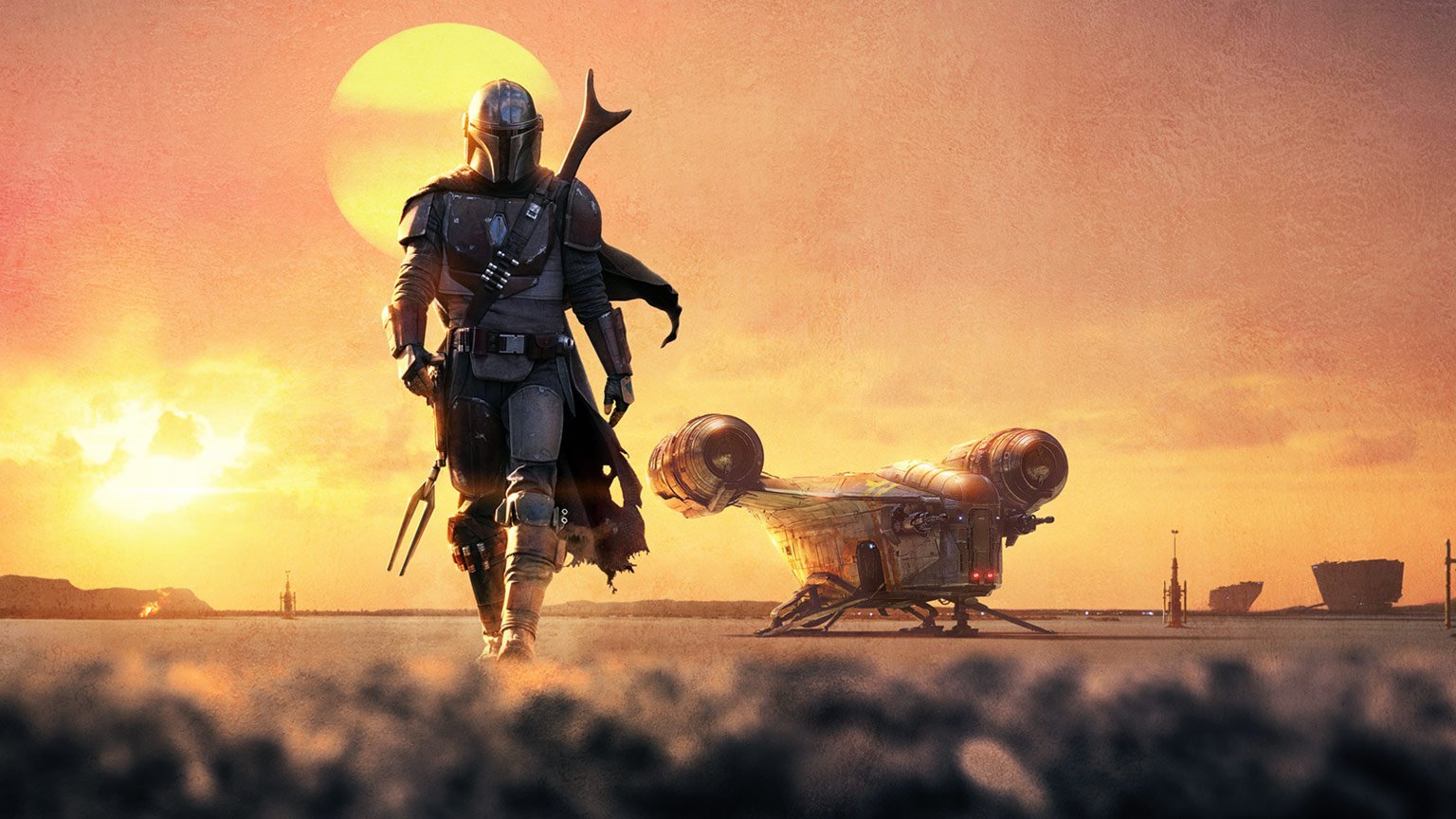
Finalized Production Prototype of the RazorCrest

Controversy has arisen like the Sith themselves over the most recent crowdfunding campaign by Hasbro; namely their Haslab Vintage Collection RazorCrest.

Originally intended to be a Disney Parks exclusive toy, the Vintage Collection RazorCrest was rushed into the Haslab domain when their intended project, a Dagobah swamp playset, received less than enthusiastic reviews at an early showing.

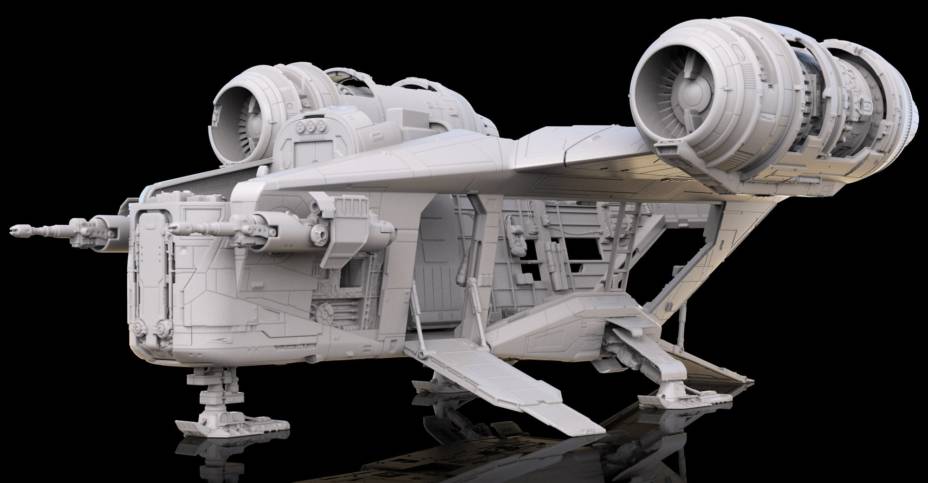
Initially fans were presented only with Gray Scale CAD renderings of the RazorCrest, and not actual images of the finalized prototype.

Before the Hasbro marketing team could blink, they had collected 9.8 million credits from twenty eight thousand backers to fund their latest idea.

The excitement throughout fandom would soon cease, however, as the shadow of the dark side was revealed.

Gray Scale 3D Rendering of the RazorCrest

During The Mandalorian Season Two Episode Six, Chapter Fourteen (The Tragedy), We find Din Djarin and Grogu on the Jedi homeworld of Tython, being attacked by remnant Imperial forces.

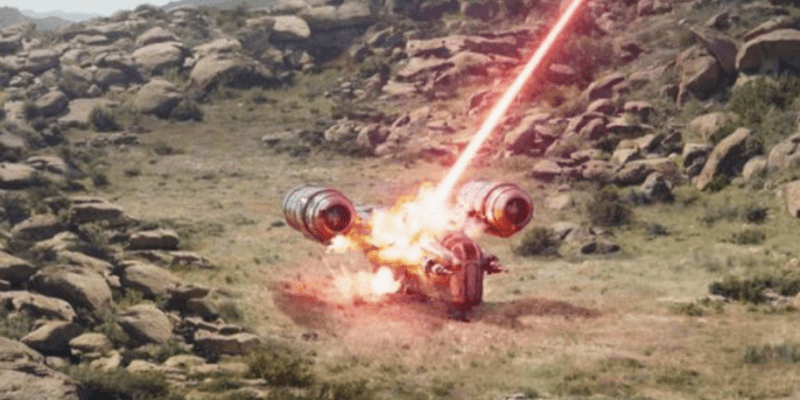
The defining moment of the episode sees the RazorCrest destroyed by a single blast from a turbolaser, with Din left speechless as his ship is vaporized in front of him.

Like Din Djarin, Backers of the Haslab RazorCrest were also left speechless, and quite frankly confused about the whole matter.

Many wanted to know why Hasbro would go to such lengths to release the RazorCrest, only to see it get destroyed within weeks of starting the campaign?

Many fans were angry, seeing it as nothing more than an expensive marketing strategy to keep fans buying toys from The Mandalorian.

For those of you who are not aware, toys for Star Wars are planned anywhere from eighteen months to three years in advance of their release, and the design team at Hasbro often works closely with the staff at Lucasfilm on their development and production.

The RazorCrest is no exception, so it stands to reason that Hasbro could have known that the iconic ship would soon meet it’s demise, a fact that did not sit well with many backers, which in turn caused them to withdraw their support.

Unlike the Millennium Falcon , the RazorCrest is a fairly new ship to the Star Wars universe, and seeing it destroyed so soon had a negative effect upon fans.

This was even more true with those who backed the Haslab project, having paid nearly four hundred dollars up front to secure their toy, and ensure it’s production goals were met.

Now it seems that Hasbro may have made an error in how they chose to release it. To be fair, any time a new concept for a toy is proposed, there are many considerations that must be reviewed.

Among these are production costs, and marketing. If it is approved to move forward, then an in house prototype is created, usually by 3D printing, and further analysis is made, along with revisions to the proof of concept model.

If it gets approved for production, then contacts have to be made for the tooling to be designed and produced, along with the actual production facilities,as well as the design and production of the packaging.

A production schedule is created, and a shipping date is given. All of which happen years before you actually see a toy on store shelves.

Like any other industry, there are financial risks involved with sales, and over the past eight years alone Hasbro has incurred an estimated five hundred million dollars in losses due to poor sales of their Star Wars brand toys.

One of the things that their marketing team would point out is that the bulk of their sales are from adult collectors and fans, rather than from parents buying toys for their kids.

This is one reason why Haslab was created, in order to give fans the toys that they really want, which would otherwise not get produced.

They began two years ago with Jabba’s Sail Barge, which saw nine thousand backers paying five hundred dollars each for the massive collectible.

Hasbro cashed in with five million dollars on that project, and I would guess that half of that was counted towards profit.

This time around Hasbro had three times as many backers for the RazorCrest, with almost double the money for a ship that has only been in existence for one tenth as long as the Sail Barge.

Clearly, the project revealed where the hearts and minds of Star Wars fans is at. That is, until they saw their new toy vaporized on screen! So what happens next?

“I might need a ride back to Navarro…”

Undoubtedly the project will move forward, and backers should still receive their product by fall 2021, barring any unforeseen circumstances that would interfere with production.

That being said, there are tens of thousands of fans out there like myself who will miss out on their chance to own the RazorCrest, simply due to cost. That is the downside to crowdfunding.

Not everyone can afford the total cost up front, and not everyone can afford to pay within the limited timeframe provided.

Whether Hasbro did or did not know about the ship’s demise is irrelevant in my opinion, as true fans of the show are still going to collect what they want, when they can.

The real issue here is the availability of the toy, and what could Haslab do differently? Given the lead time, I think that what is needed is a separate website that is financed in part, by an annual membership fee from collectors.

This would provide an opportunity for the design and marketing team to present fans with opportunities to provide feedback and input on future projects.

It could also provide them with a secure portal to set up a payment system for future Haslab projects. Doing so would ensure the projects still get funded, while allowing more fans to take part, and be able to share in the fun of having their own special toy for their collection.

It would also help to deter scalpers who are making money off of the current project, by offering it for twice the retail cost on the secondary market.

Even if we don’t see Din Djarin in another model of the RazorCrest , the ship will go down in history as one of the most iconic within the Star Wars universe.

And if you didn’t get in on the Haslab project, don’t fret, as there are always plans for 3D printed models like the one that I own online.

Here’s a link you can check out by Fine_Engineer with his free plans for the RazorCrest : https://www.thingiverse.com/thing:4607202

My 3D printed RazorCrest from the files provided on thingverse by fine_engineer. The ship was upscaled 150% to accommodate the Black Series figures.

The Mandalorian: Season Two Finale

This morning I watched The Mandalorian Season Two finale The Rescue, and I wanted to share my thoughts on it, as well as my thoughts on where the show may go next season.

To begin, I have to say that it was an incredible story, that had an appropriate balance between the action and the drama taking place.

The Mandalorian Season Two has been much better than the first season in my opinion, and has been much more fascinating overall.

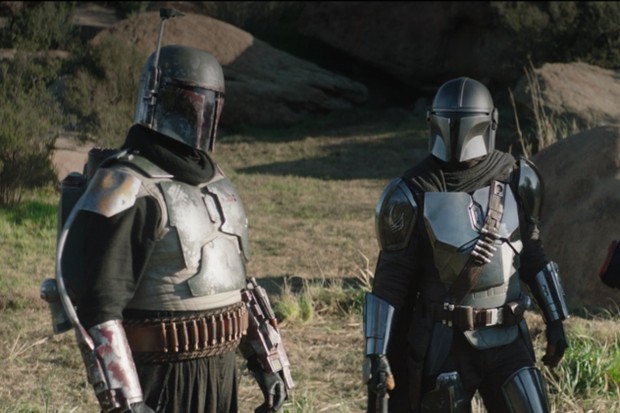
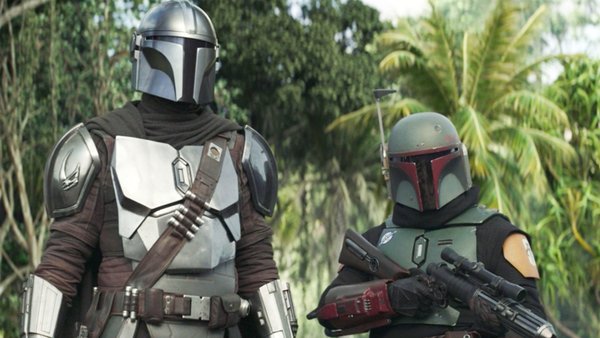
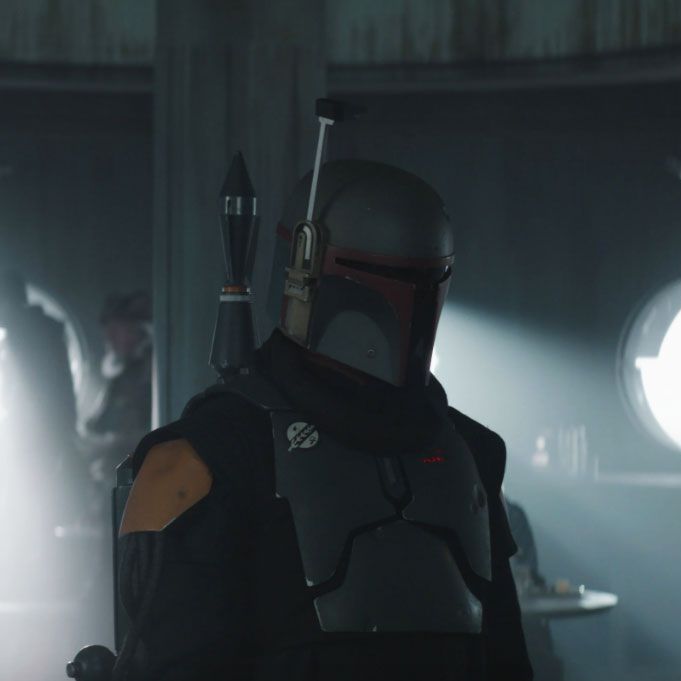
The most important aspect of Season Two in my opinion has been Boba Fett; the writers decision to bring him into the narrative was probably the smartest move that they made.

What I didn’t care for was Bo Katan’s criticism of him, saying that he isn’t a Mandalorian, because he is a clone of Jango Fett.

If you notice in his response, Bobba always responds with Jango being his father, because that is who he really was.

For whatever reason Jango wanted a descendant, an heir, a son, and the only way that he could have that was by asking for a clone of himself to raise as his own.

Other than being a clone, Bobba was unaltered genetically, making him for all intents and purposes human.

It also means that according to The Way, Jango had chosen to raise him as his own, and this in itself made Boba his heir.

It also means that because Jango was a descendant of Jaster Mereel, that Boba is the direct descendant and heir to the throne of Mandalore, and not Bo Katan as she claims.

This presents an interesting angle to the narrative for Season three, since Din is in possession of the Darksaber, which by birthright should belong to Boba Fett.

The other aspect of the Season Two finale that I want to discuss Is Din, and his relationship with Grogu.

In all honesty I was not expecting Grogu to be rescued this season; my thoughts were that the show would follow a similar arc as The Empire Strikes Back, and end in a cliffhanger.

Surprisingly, the ending was presented in such a manner as it could continue, or it could be end the show if they so chose to do so.

That being said, we know that there is a third season planned, so where will the narrative go from here?

My guess is that there are niue answers forthcoming from Dr. Pershing and Moff Gideon as to what exactly they were doing with Grogu, and why they neede his blood.

I also expect that at some point we will see Grogu and The Mandalorian cross paths again, possibly at the end of Season Three as a final farewell.

With that being said, I think that the remaining stories still revolve around the answers surrounding Moff Gideon, and possibly Din having to go on a series of missions that in some way either assist the Jedi, the New Republic, or both.

I also expect to see a continuation of the narrative between Boba Fett and Din, or at least having their paths cross again.

Boba Fett has become more than a supporting role in the show, he is now just as important and prominent as Din Djarin.

The Mandalorian has all of the elements present that make it what George Lucas always envisioned for Star Wars to be.

It has the action that we see in the Flash Gordon serials of yesterday, but it lacks the feel of a science fiction western.

Whatever your feelings and thoughts are, The Mandalorian has captivated millions of fans worldwide, and forever established a new hero in the Star Wars mythology.

Quintessa: The Key of Cybertron

transformers-the-last-knight-1551477143
Quintessa in Transformers The Last Knight

For those of you who actually enjoyed the live action Transformers films, I wanted to share a thought with all of you about the continuity of the movieverse plot.

Like many fans, I enjoyed the live action franchise, despite there being questions that were left unanswered at the ending of Transformers The Last Knight.

One of the most divisive of these is in regards to Quintessa, who she is, and where she comes from. After all, we learned from Optimus Prime in the first live action film that the AllSpark created worlds, and filled them with life, and that was how the Transformers race was born.

If that is correct, then someone intelligent was responsible for the creation of the AllSpark. That someone is most likely Quintessa.

According to an interview with Lorenzo Di Bonaventura (https://www.slashfilm.com/transformers-the-last-knight-credits-scene/) Quintessa is or was at some point human, but if that’s true then what is she now?

To answer that we have to look at the intro to Transformers Age of Extinction, where we are introduced to an armada of alien vessels entering the atmosphere of prehistoric Earth.

Here we see them deploying objects which hover above the ground, and are then detonated, turning organic material into molten metal.

We also are given a glimpse of these aliens onboard their ship, who are clearly biological entities, with mechanical enhancements.

We later learn that these devices Cyber form entire worlds, and the Living Metal is harvested and returned to Cybertron where it was used for among other things, to build the Transformers race.

Arcam’s Razor dictates that the most reasonable explanation is the correct one, and operating on that theory we can presume that the race of creators visited worlds which were uninhabited by sentient life, and Cyber formed them.

I suggest this because in Transformers Revenge of the Fallen we learn that the Thirteen Primes set out to find uninhabited worlds on which to build Star Harvesters.

Rotf-starharvester-2
Cybertronian Star Harvester constructed on ancient Earth

These devices would detonate a local star, capturing it’s plasma and converting it into raw Energon. Doing so was the only way in which they could recharge the AllSpark once it was drained.

So unlike the Transformers themselves which rely on liquid Energon which has been processed from the ore, the AllSpark as Ratchet claims in Transformers contains raw power, which cannot be controlled by any Transformer themselves.

It leads us to consider then that the Creators used the Thirteen Primes to harvest power for the AllSpark, and set them over the race of Transformers, who were most likely used as laborers to do the creators bidding.

The only element that is left in question then is Quintessa, and it is clear from the interview with Lorenzo Di Bonaventura that they have already established a backstory for her.

Based on his statement, we can gather that Quintessa was originally a human being from Earth. We can also presume that she most likely survived a Cyber forming mission by the alien race, who captured her and retuned her to Cybertron.

There she was studied, and somehow integrated with their own technology, turning her into a life form unlike anything that was previously known.

This transformation gave Quintessa abilities and knowledge that no human would have been capable of having, and thus made her an asset to their race.

Quintessa would have eventually learned of Unicron’s existence, and known that in the future that she could not defeat the creators alone.

Thus she created for them a race of laborers using the AllSpark, with the intention of having them destroy both the creators and Unicron in the future, leaving only Quintessa to rule over Cybertron.

It would become her ultimate act of vengence from being taken from her world, and having it seemingly destroyed.

The eventual rise to power of Megatron, and his rebellion of the creators was most likely an uncalculated event for Quintessa, but one that she allowed in order to fulfill her own purpose.

Like the Fallen and Vector Prime, Quintessa appears to have the ability to teleport herself through the fabric of time and space, if only over short distances.

We could then surmise that she hid herself within Cybertron during the war, most likely surrounded by Autobot guardian knights who were oblivious to her intent.

Those who were escaped before she could kill them. The war ended as the AllSpark was launched into space, and without it Quintessa did not have the power to restore Cybertron on her own, leading to the events in each film.

The movieverse plot involved Megatron  recovering the AllSpark, and the Fallen using the Star Harvester to recharge it’s power.

They would have then used the AllSpark to revive Sentinel Prime in order to teleport Cybertron to Earth, allowing Quintessa to kill Unicron once and for all.

Had Transformers 6 been written, we may very well have seen Unicron’s power harnessed by Quintessa to complete her original goals.

This summary has taken me nine years to complete, believe it or not, as I spent hundreds of hours doing research on this subject. I hope that it provides a takeaway for all of the movie verse fans, as well as presenting a closer look at things for those who were critical of the live action films.

Cybertron awaiting 91263 High Quality and Resolution Wallpapers
Cybertron restored and departing Earth


A visitor’s guide to Galaxy’s Edge

star_wars_galaxy_s_edge1000x750
The Millennium Falcon arrives at Black Spire Outpost on Batuu

With an early spring upon us, you can bet that many families will be planning for early vacations this year, and that includes trips to Walt Disney Land in California, and Disney’s Hollywood Studios Theme Park in Florida.

Both of these parks continue to change and expand their attractions to entertain guests, and the latest hype is all about their new immersive Star Wars themed attraction called Galaxy’s Edge.

In this blog, my goal is to provide you with a bit of history on what exactly Galaxy’s Edge is, how it was built, and what specific attractions and features it includes.

I will also provide you with insight into plans for both parks, and let you know if it’s worth your expense and time. So, strap in, and let’s see what all the hype is really about.

Concepts and Imagineering

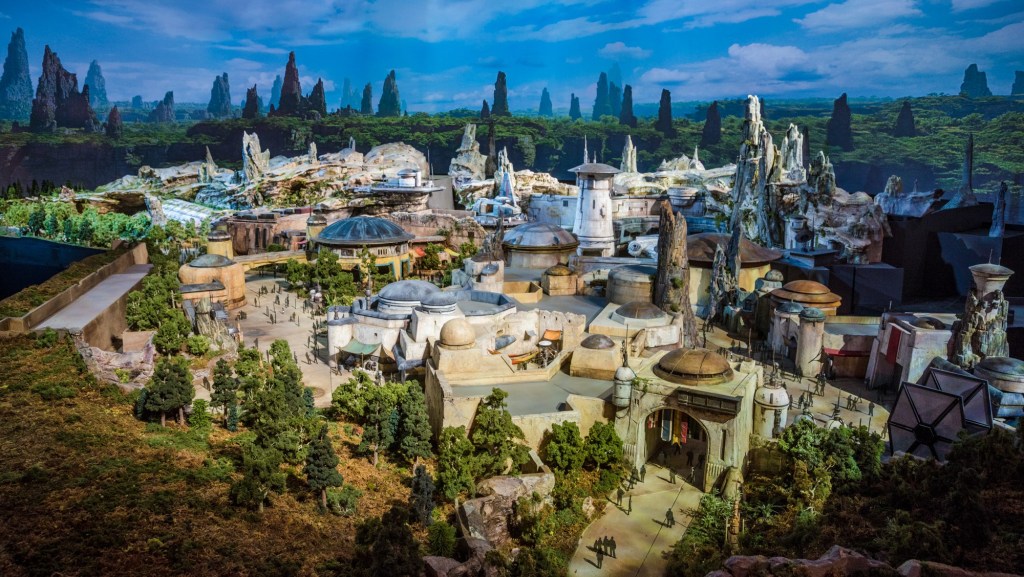
Modeled after the Black Spire Outpost on the fictional world of Batuu, Galaxy’s Edge is an ambitious collaboration between Disney and Lucasfilm, which was first announced by Disney CEO Bob Iger at the D23 Expo in August of 2015.

Construction on both sites began in April 2016, with the Anaheim park opening first on May 31st 2019, followed by the Florida location on August 29th of the same year.

Both locations encompass fourteen acres of land, and cost around one billion dollars to construct at each park. Both sites occupy areas that were formerly shut down for other attractions.

In addition, certain areas of both parks had to be redesigned to allow for the new Star Wars themed area to be constructed.

Galaxy’s Edge features two attractions, Rise of the Resistance, and Smugglers Run, as well as cast members from both the Resistance and First Order who interact with guests.

There are also thirteen food vendors and shops, which I will provide a brief summary of in the following paragraphs.

Star-Wars-Galaxy-Edge
Galaxy’s Edge Concept Model

Galaxy’s Edge was originally designed to be an environmentally immersive experience, allowing guests to participate in actual role play scenarios with cast members.

They would receive an assignment upon arrival, and visit different areas around Black Spire Outpost in search of clues for their next assignment.

Guests were meant to encounter actual Holograms of characters in broad daylight, and witness lightsaber duels between Jedi and Sith.

Autonomous droids were planned to randomly wheel themselves about, while guests would be hunted down by Stormtroopers.

In addition, there was a life size animatronic Dewback that guests could ride on. Although Disney submitted various patents to the U.S. Patent office for new technologies, none of these planned concepts have yet to become a reality.

For fans who knew about them like I did, it was a severe disappointment. Currently there are plans to open a massive interactive hotel experience called the Halcyon at Galaxy’s Edge in Orlando.

Construction has already begun on the project, and it will be a multi-day immersive experience involving interaction and role play amongst guests and cast members.

So what do you really get for your money? Read on.

What a piece of junk!

Nestled among the towering spires of the outpost is a life size reproduction of the Iconic Millennium Falcon.

At one hundred feet in length and one hundred thirty feet wide it is the most prominent feature of Galaxy’s Edge, and it’s also serves as the entrance to the Smuggler’s Run attraction.

This attraction allows up to four guests to serve in various roles who must work together as a team to fly and fight the Millennium Falcon through a mission.

Though there are guests who visit Galaxy’s Edge just to have their picture taken in front of the Falcon, it isn’t alone.

Scattered around the location you will find several T-70 X-Wing starfighters, as well as an RZ-2 A -Wing Interceptor.

Since the First Order maintains a presence on the planet, you will find several of their ships present as well. There are heroes from both sides present to greet and interrogate you, and if you aren’t careful your activities will be closely monitored by the First Order. 

The second attraction in the land is known as Rise of the Resistance, and in my opinion isn’t that great. Guests essentially are seated in a droid controlled transport and “ride” through various scenes with special effects. In all honesty I was not impressed by it.

Millennium-Falcon
The Millennium Falcon at Galaxy’s Edge

Food and Merchandise Vendors

The following is a brief synopsis of the thirteen on site food and merchandise vendors located at Galaxy’s Edge:

Docking Bay 7 Food and Cargo: A full service restaurant inside of a functioning hanger bay.

Kat Saka’s Kettle: An outdoor food stand where guests can purchase a unique snack made from popcorn.

The Milk stand: If you’re a fan of Blue Bantha Milk, then this is one place where you’ll find it!

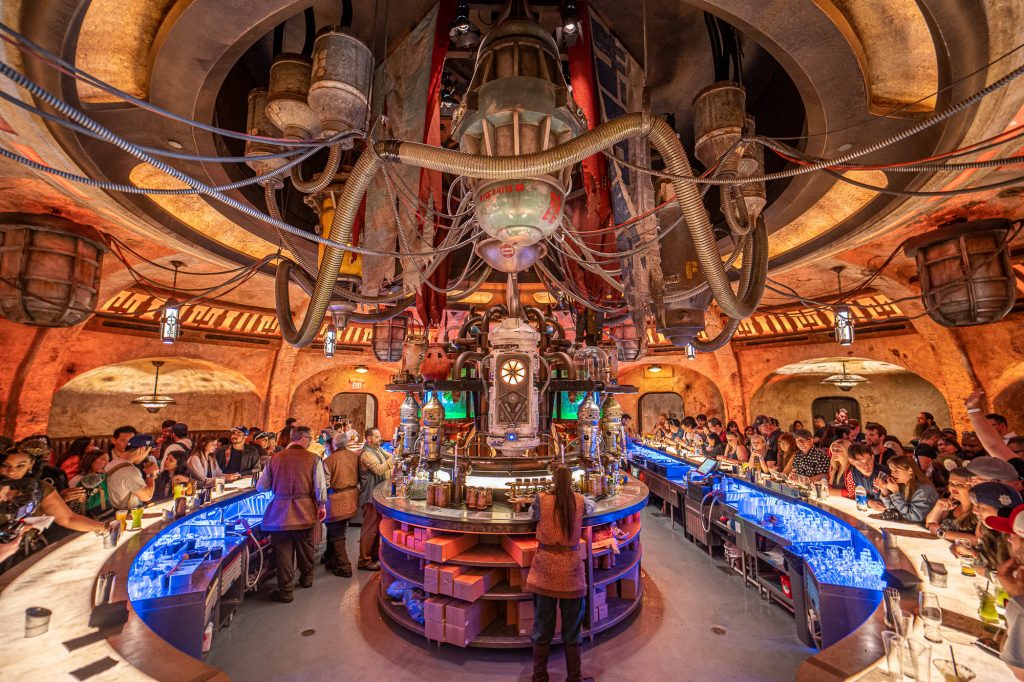
Oga’s Cantina: Probably the most awesome place in the park, it’s a restaurant and Cantina with a full size bar, where you can sample drinks from across the galaxy.
ogas-cantina-review-interior-1-1024x682
Oga’s Cantina

Ronto Roasters: Another outdoor food vendor featuring grilled pork and sausage wraps.

Bina’s Creature Stall: This is a shop full of plush animals and creatures from throughout the galaxy. My favorite: The TaunTaun!

Black Spire Outfitters: One of if not my favorite shops at Galaxy’s Edge, it offers travelers the opportunity to purchase the exact garments worn by the natives of Batuu!

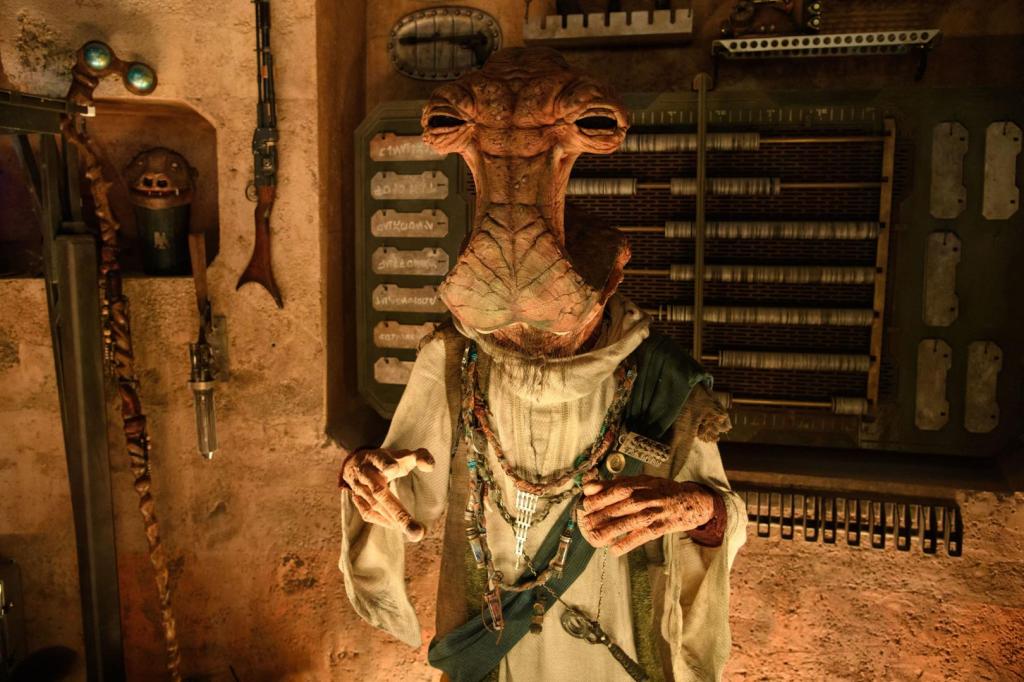
Dok-Ondar’s Den of Antiquities: Travelers will find ancient artifacts of both the Jedi and Sith in this fascinating shop, including Holocrons and Khyber Crystals.

Dok-Ondar-Banner
Dok-Ondar an Ithorian shop owner

First Order Cargo: If you’re looking to join the First Order, then this is the place to buy your equipment and uniforms.

Mubo’s Droid Depot: Another favorite of literally every guest, you can build your very own BB or R2 droid here from a variety of parts in various colors, and get a backpack to carry it in!

Resistance Supply: If you want to get in the fight, then this is the place to get equipped to do it!

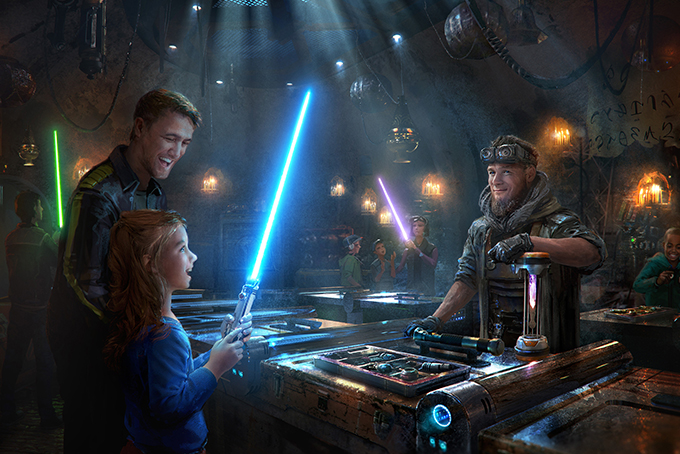
Savi’s Workshop: This location bears the most attention, as it is the number one location visited by guests.

Here you pay to go into an ancient shop that serves as a front to hide it’s true purpose, as a supplier of the most ancient and forbidden weapon in the galaxy: a lightsaber!

Guests are lined up, and make several choices while in line, before being ushered to a work station.

Here a cast member walks the guest through what I can only describe as a spiritual experience of constructing a lightsaber from real metallic parts, and choosing a crystal to power it.

The final act is to install their lightsaber hilt into a port where it connects to a blade that the guest has chosen.

There are various colors and crystals to choose from, and each crystal is unique in how it gives a lightsaber it ‘s color, light, and sound effects.

Rare crystals can be purchased at Dok-Ondar’s Den of Antiquities. Though expensive, it is truly a once in a lifetime experience and worth the cost.

Star-Wars-Galaxys-Edge-Savis-Workshop-Handbuilt-Lightsabers-1
Savi’s Workshop

Toydarian Toyshop: a shop featuring hand made toys from around the galaxy.

Is it worth my time and money?

Now that you have a better idea of what Galaxy’s Edge is all about, you’re probably asking yourself is it worth the extra cost?

To be fair, any trip to the Disney parks is expensive, meals included. On average, it costs one adult about two hundred dollars for park admission for one day, three meals and drinks, and a snack.

For the younglings, you get to save about ten percent of that cost. If you plan to buy collectibles and souvenirs, then you should research their cost and plan accordingly.

The bid ticket items are the build your own lightsabers which go for around $225.00, as do the Resistance fight suits and Jedi robes.

If you want a professional photo in front of the Millennium Falcon, a cast member can snag one for you for only fifteen dollars!

If you’re super rich and have money to throw away, you can buy Stormtrooper armor for just under seven thousand dollars, or a full size radio control astromech for twenty five thousand dollars ( No, I am not kidding).

If that’s too much to take in, you can grab a Blue Milk for a whopping eight dollars, and head for the next transport home.

Blue-Milk-Green-Milk-Galaxys-Edge-e1559333552129
Bantha Milk anyone?

Overall I would say that yes galaxy’s edge is worth the cost, particularly if you have kids. Everyone knows what Star Wars is, and there’s something there that almost anyone can enjoy and relate to.

While there you’re hear cast members use certain phrases to refer to real world items in universe (a cell phone is a data pad, the restroom is the fresher), and they will readily interact with you at any time.

It’s a great way to escape all of the negativity of everyday life, and that’s one of the reasons that Walt Disney designed his parks the way that he did. It’s meant to be a form of escape, and who couldn’t use an adventure in a galaxy far, far, away?


Star Wars update for Collectors

VintageCollection

In the image below is a figure released in Q3 of 2019, the Imperial Stormtrooper from Rogue One: A Star Wars Story.

It’s a figure that I wanted to use as a troop builder, and had planned to buy at least two squads of them ( sixteen figures in all).

Recently I couldn’t find it at retail, so I began searching for it online, and I have to admit that I  was both shocked and upset by what I found.

On average the figure was selling for roughly thirty dollars, which is more than double it’s original Manufacturers Suggested Retail Price ( MSRP).

I ended up buying three of them for sixty five dollars on Ebay; far short of my intended goal thus far.

I wanted to take a moment and share with everyone some details on this figure, as well as some of the factors that may have contributed to the small fortune that I’m preparing to invest into a group of Stormtroopers.

Though there have been many variations on this figure released over the years, this one has been considered the best sculpt yet, Perhaps that’s one of the reasons why it’s value on the secondary market has more than doubled in less than a year.

Generally speaking, you don’t see too many figures that jump in value in such a short period of time, without them being considered rare.

Moreover, the Vintage Collection consists of super articulated figures, with many being re- released with Hasbro’s proprietary Photo Real technology for collectors.

Still, it’s hard to grasp a Stormtrooper being catapulted to such demand; or is it? One of the things that you have to learn as a collector is that a figure is essentially worth what you are willing to pay for it.

It is still a toy, however toys in general can become extremely collectible, and Star Wars is certainly no exception.

When action figures for A New Hope were first revealed in 1977, they sold out before they were even produced, causing Kenner to issue early bird certificates for the following year.

Star Wars toy sales continued to exceed expectations through 1983, before beginning to decline after the release of Return of the Jedi.

The line was revived in 1995, where again, it continued to see demand among collectors. Though Hasbro had plans to cancel the line in the early 2000s, it didn’t happen, and the brand has been on store shelves ever since.

Beginning in 2015 sales began a sharp decline, and Hasbro has lost an estimated 500 million in revenue in Star Wars toys over the last five years.

The sequel films by Disney have raked in the cash, but have not been received well by fans. In addition, Hasbro has made changes to the Star Wars line, which has also affected what they produce and in what quantity.

Generally speaking the bulk of Hasbro’s toy sales for Star Wars comes from adult collectors, so it only makes sense to invest more into marketing to collectors than kids.

Until 2019 Star Wars always featured a basic assortment of figures that were 3.75 inches in height, and had a minimum amount of articulation (five POA in most cases), as well as playsets and vehicles to accompany them.

star-wars-the-force-awakens-3-75-inch-action-figure-snow-and-desert-wave-4-stormtrooper-squad-leader-pre-order-ships-feb-2016-9
Basic Assortment figure from Star Wars The Force Awakens (2015)

Last year that changed with the discontinuation of the 5 POA line, which most likely was done as a cost saving measure due in part to poor sales.

The focus then, was placed upon the highly successful Vintage Collection, an ongoing line of super articulated and highly detailed 3.75 action figures.

The line initially ran from 2010 until 2013, before being brought back in 2018. It is now Hasbro’s only 3.75 production line for the Star Wars brand.

The Vintage Collection also features vehicles and ships that are more accurately scaled, and highly detailed, with multiple features for collectors.

One of the aspects of this line has been to re-release certain figures, and the Imperial Stormtrooper is one of those.

Taking the Stormtroopers from Rogue One as a guide, the new Vintage Collection figure has been referred to by collector’s as the most detailed version of the trooper yet, and perhaps that is one reason for it’s increase in value.

e0370-sw-vc-w6-e4058-imp-stormtrooper-01
The Vintage Collection Rogue One Stormtrooper (2019)

Other factors may be due to poor distribution by retailers, particularly Wal-Mart, who is known for placing these figures on clearance within a couple of months of being released.

Another factor may be a limited production run, which would have contributed to greater demand on the collector’s market.

Also to be considered is future product being halted by the Coronavirus outbreak. Though Hasbro had already shifted some of it’s production to Vietnam in 2017, it is conceivable that they were still using production facilities in China, which have all been closed for the foreseeable future.

This means that all planned waves will be delayed, and this was made clear at New York Toy Fair this past weekend. Often future waves will feature at least one repack, and the Rogue One Stormtrooper is one of those.

The final aspect that drives cost on the secondary market is scalping, which unfortunately is an all too common occurrence.

There are people out there who are fans or otherwise, and who keep track of the values of these figures, and use that to take advantage of people like myself who couldn’t find the figure at retail, and are then forced to pay whatever they demand in order to get it.

Sadly, there are online toy retailers who do the same thing. Ultimately, it’s up to you as a collector to decide if you’re willing to pay what a buyer is asking, or to wait it out and see if the price drops within the next quarter.

Generally speaking if the item is out of production you can expect the value to continue to increase, and with it it’s cost on the secondary market.

This is when you have to learn to patiently search every site and every listing in order to get the best price for a particular item.

Though time consuming, It’s quite fun in it’s own right shopping for toys. Before I became disabled I used to drive hundreds of miles and spend an equal amount of money searching for action figures and vehicles for my collection.

I hope that this article has both entertained and informed you on some of the aspects of collecting Star Wars action figures, and why they sale for what they do.

Perhaps you aren’t a collector or fan, but perhaps now that you have gained some new insight into what drives those of us who are, you will have gained a new appreciation and understanding into toy collecting as both a hobby and a passion. Until next time, Good hunting, and May the Force be with you!

What Happened to G.I. Joe ?

1920x1200-gi-joe-logo5

Introduction

What happened to G.I. Joe? It’s a question that I’ve found myself asking more than once over the years; particularly since G.I. Joe The Rise of Cobra hit theaters back in 2009.

I’m a big fan of the franchise, having grown up watching the cartoon, and owning most of the original toys from the 3.75 line, as well as some of the Hall of Fame twelve inch figures in the nineties.

G.I. Joe represented the pinnacle of boy’s toys, and was a great moral example to all of America’s youth, finding fans in both it’s intended market, as well as with young girls.

That’s right; G.I. Joe kicked ken out of the doll house, and stole Barbie’s heart from day one, and we’ve never looked back!

All kidding aside, that’s how great G.I. Joe became, and how fun it was to play with them. So what happened to America’s favorite hero?

In all honesty, that depends on who you ask, as well as what their involvement is in the franchise. In this article I’m going to present a brief overview of the history of G.I. Joe, and attempt to answer that question based upon the Intel at hand.

Humble Beginnings

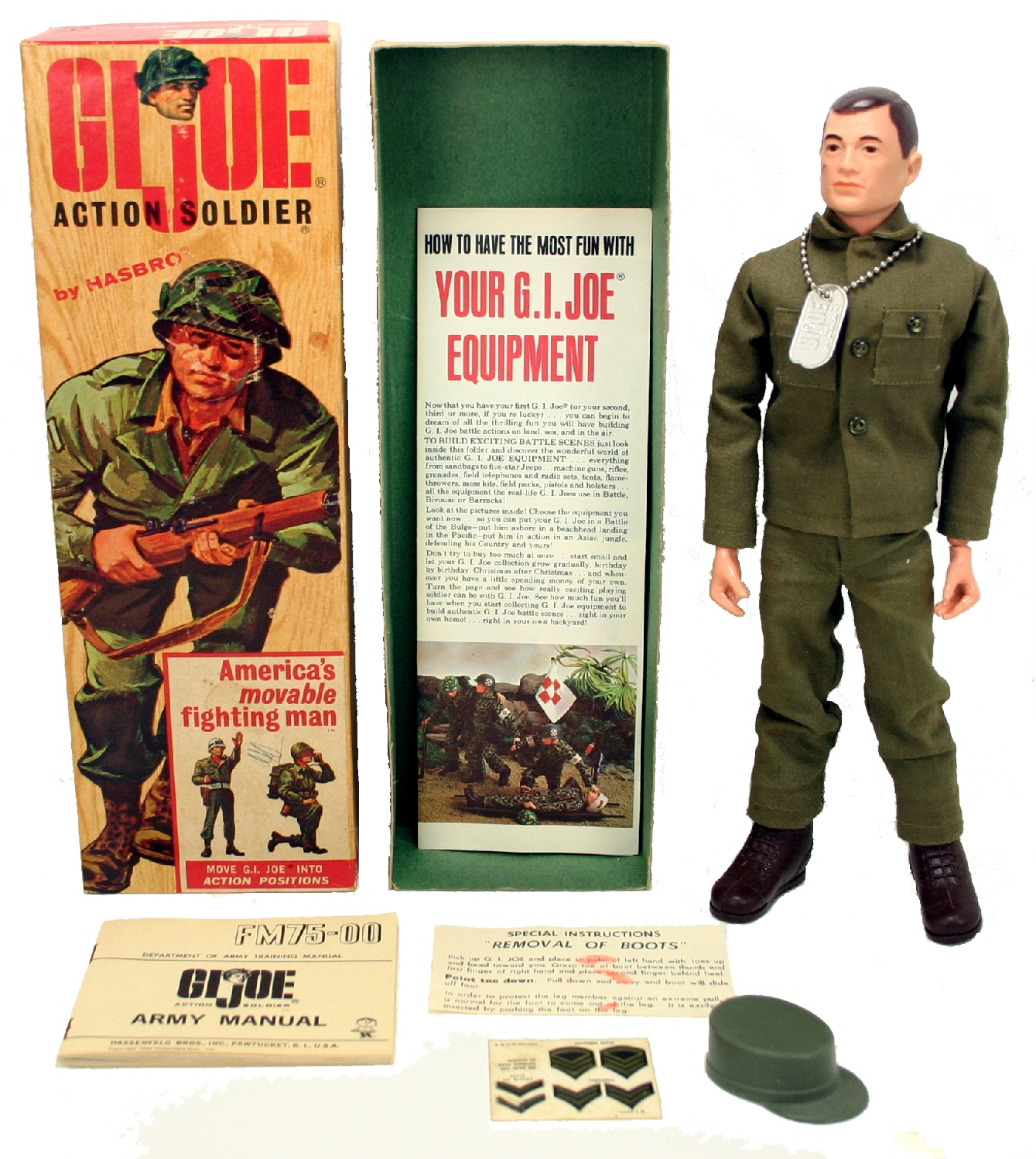
G.I. Joe was originally created in 1963 by a licensing agent in Manhattan named Stan Weston. Mr. Weston actually made the first prototypes of a twelve inch action figure himself.

He eventually showed them to an executive at Hasbro named Donald Levine. Weston subsequently sold the license for G.I. Joe to Hasbro for One hundred thousand dollars.

Whether or not Weston was entitled to a percentage of any of the profits in his contract is unclear, however the success of G.I. Joe is not.

One of the most important decisions made by Hasbro early on involved the marketing of their new product. It was not acceptable to call G.I. Joe a doll, as no parent would buy their son a doll made for boys.

Instead, the term “Action Figure” was coined by Levine to describe G.I. Joe, and the figures were subsequently marketed with the trademark  “America’s movable fighting man” on their packaging.

The first figures hit store shelves in 1964, and featured an Army Soldier, a Marine, a fighter pilot, and a sailor. These figures were produced until 1969.

7500
An original G.I. Joe action figure

In 1970 Hasbro made changes to the G.I. Joe line in response to the ongoing negative criticism of the Vietnam war in Southeast Asia.

The line was renamed “Adventure Team”, and departed from military themed service members to provide action and adventure characters from various settings.

Along with the name change Hasbro also incorporated several innovations, including rooted life like hair and beards, as well as a new mold for the figure’s hands dubbed “Kung Fu” grip, allowing them to better grip accessories.

G.I. Joe saw success in other nations as well, due greatly to the figures being licensed by Palitoy Limited, an English toy manufacturer who produced the figures under a license agreement with Hasbro.

The Palitoy figures were released under the title of “ Action Man” from 1966 until 1984, and were distributed in other nations as well by various companies.

A Real American Hero

1982 would see the G.I. Joe toy franchise return in a new smaller format of 3.75 inches. These figures were the same scale as the current Star Wars action figures, but with more points of articulation.

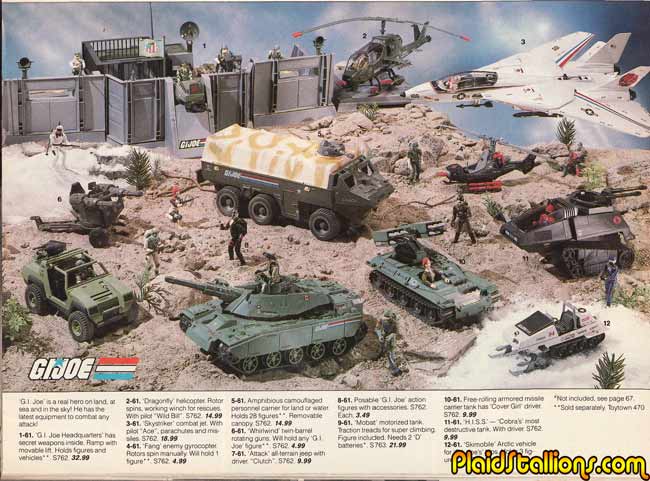
Tie-in marketing was pioneered with the G.I. Joe line, as the launch of the new figures was incorporated with the animated cartoon series, as well as an ongoing comic book title.

Ancillary sales were also generated during this time from other merchandise such as lunch boxes, clothing, and role play toys.

Reducing the scale of the figures to 3.75 inches had the additional benefit of allowing Hasbro to design and produce vehicles and play sets for the figures, and this helped drive G.I. Joe as one of the most popular toy lines for boys during it’s run.

The line continued throughout the eighties and nineties until its cancellation in 1994. Though the primary line for G.I. Joe had come to an end, Hasbro would revive the franchise for various limited assortments that were primarily marketed to collectors.

Each of these sub lines ran for a year to four years, and carried on the G.I. Joe line from 1997 until 2009.

gijoeplaidstallions
A G.I. Joe toy ad from 1982

The Rise of Cobra

2009 was a great year for G.I. Joe fans, as we got to see our childhood heroes on the big screen. For the first time ever, the story of G.I. Joe had been turned into a live action movie.

The movie was directed by Stephen Sommers, and opened to audiences on August 07, 2009. It was number one on it’s opening weekend, and It went on to gross three hundred million worldwide, but received a lot of criticism as well as fan backlash.

One of the most agreed upon negative aspects of the film was the actor Marlon Wayans, whose character Ripcord did not resemble the original character, and spent the entire film attempting to flirt with Scarlett.

There were other aspects of the film that detracted from the original G.I. Joe that fans have come to know and love, and the numbers reflect that.

Hasbro released a product line to coincide with the film’s release which was well received for the most part by collectors, and has gone on to nearly triple in value on the secondary market today.

1024x768-beret
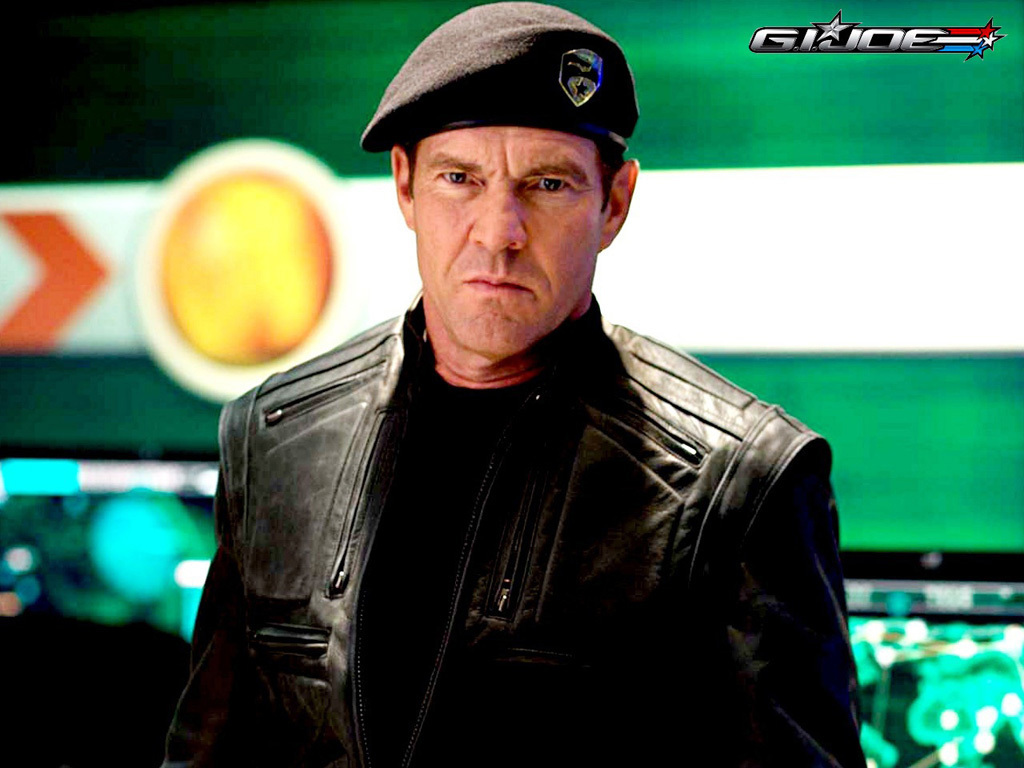
General Hawk from G.I. Joe The Rise of Cobra

G.I. Joe Retaliation

G.I. Joes next outing at the big screen was more of a soft reboot than a direct sequel, which featured new characters and an absence of the overall science fiction aspect that was prevalent in the first film.

It was a more realistic movie, however it suffered from some very critical mistakes. The first problem to arise was the change in directors. John Chu had never directed an action movie, though he is quoted as being a fan of the franchise.

I think this hurt this film severely, and had the studio brought back Stephen Sommers to direct the sequel, I think that a more successful film franchise would have been established.

The next error maxe by the studios was to push back the opening date from June 2012 to March 2013. The stated reasoning was to convert the film to 3D, however rumors gave a different reason.

Due to the late decision to move the release back, the marketing campaign was in full swing, including with Hasbro.

The toy giant had already shipped product to retailers nationwide, and toys were already on store shelves and being sold when Hasbro issued a recall of the merchandise.

It was finally decided to allow current stock to sell down, and toys were re-shipped again in March 2013. The film opened to mostly negative reviews, which did not sit well for the franchise.

default
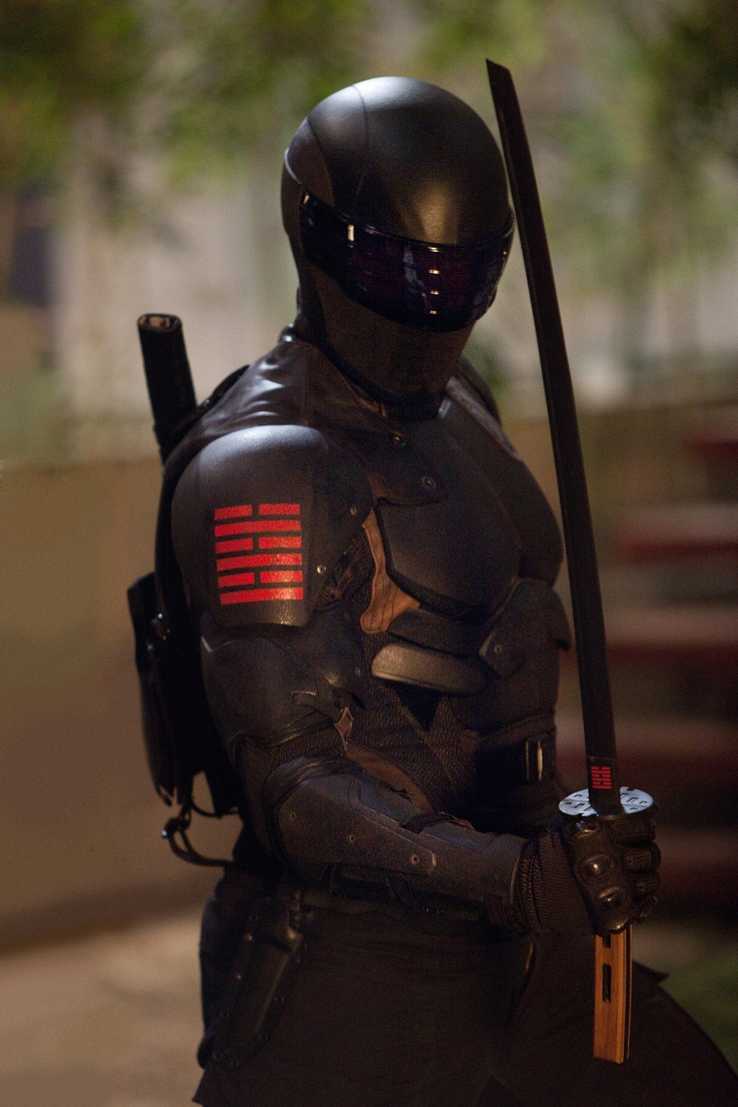
Snake eyes in G.I. Joe Retaliation

G.I. Joe Snake Eyes

With the failure of two major motion pictures based upon Hasbro’s most successful toy line, you can imagine that fans were left feeling disappointed and frustrated.

To compound that, anytime toy sales don’t meet projected goals, then things get cut, and so it has been with G.I. Joe.

To make matters worse, it seems that studio execs haven’t learned anything from their past mistakes, as a third G.I. Joe movie is set to be released this summer.

This time it’s an origin story of the character Snake Eyes, and rather than abide by the character’s origins as creator Larry Hama had written, the character will now be an Asian male, rather than a Caucasian Army Veteran.

I suspect this decision was made to appeal to the Asian film market, rather than to try and reboot the franchise for the G.I. Joe fan base here in America. Fans here are already upset about the decision, and the film hasn’t even finished production yet!

G.I. Joe versus the cultural and political foes

So why did G.I. Joe quietly disappeared from store shelves, and cease to be the cultural icon and best selling boy’s toy line in America?

First, the original cartoon came to an end in 1989, followed by it’s successor in 1991. Shortly there after in 1994 the G.I. Joe Comic series came to an end, and with it the toy line.

Though there have been at least a dozen separate G.I. Joe sub lines released by Hasbro, none of them saw the success that the originals did, and were mainly purchased by collectors.

From a cultural standpoint, the G.I. Joe brand as a whole saw a decline in interest due in part to a change in what young boys were being presented with.

New cartoons and toys with an emphasis on technology steadily became the norm, until cartoons have all but vanished.

Gone are the daily cartoons in the morning before school, and in the afternoon to keep kids entertained. These were both prime slots for brands like G.I. Joe.

The action figure craze of the eighties has been replaced by cell phones and tablets and video games.

Moreover, there has been a fundamental shift away from the ethics and morality that my generation was raised to abide by.

Boys today are not raised or taught to become strong young men and future leaders; rather they are deprived of the masculinity and sense of manhood that we are inherently born with.

God made us to be men and women, and in today’s society people have abandoned that moral compass in favor of pretending to be something that they are not.

In addition to these factors, we have also seen an increase in military conflicts and violent crimes committed with firearms, which no doubt have caused executives at Hasbro and other companies to question the results of producing military action figures and vehicles bristling with weapons.

That in itself is evidence of the mindset of the culture in which we live. In closing, I would say if anything our young children need a positive role model to look up to, and something to give them a sense of right and wrong that they can relate to.

A renewed G.I. Joe cartoon and toy line would be a great way to do that. It would help them see what I saw growing up: good versus evil, right from wrong.

Choices and the consequences, as well as courage, discipline, honor, integrity, and valor. These are the characteristics that G.I. Joe presented to my generation on a weekly basis, and they could again. Now you know, and knowing is half the battle.  Yo Joe!

The Mandalorian

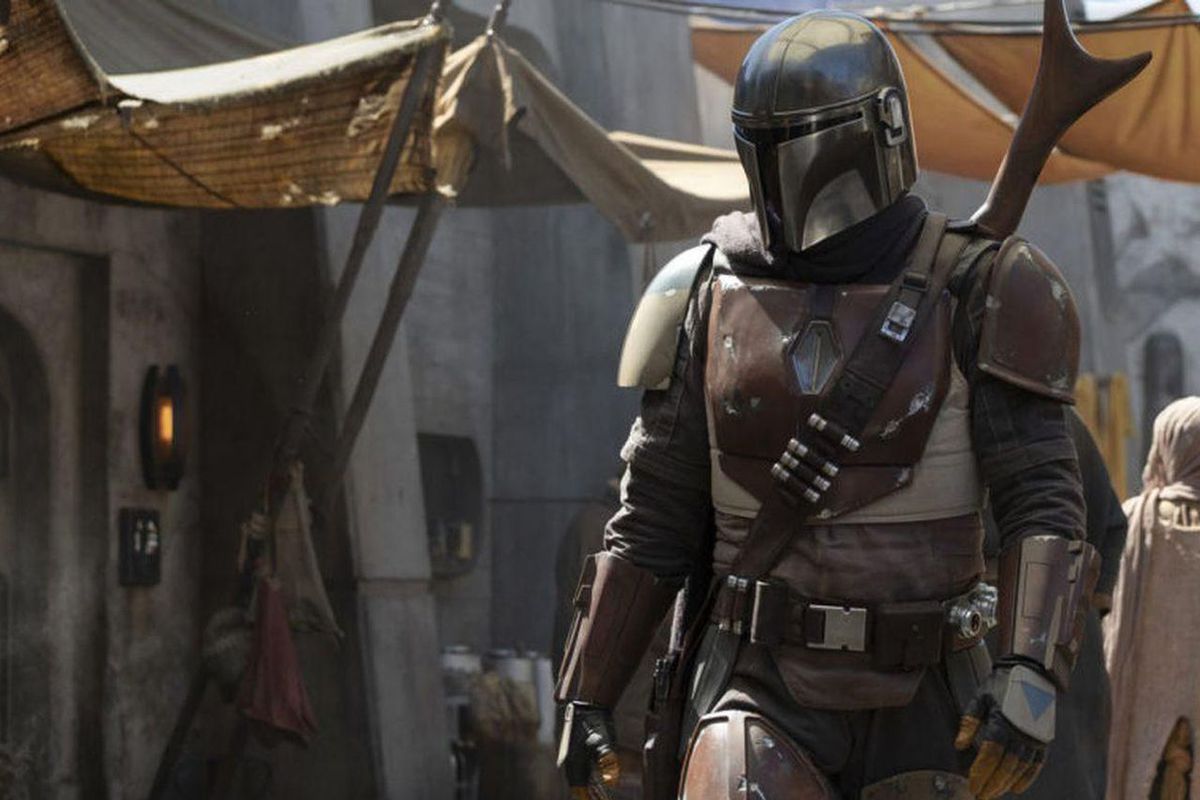
d23-the-mandalorian-poster-tall-A.jpg

For months now the anticipation and excitement surrounding Disney’s new live action Star Wars series The Mandalorian has permeated social media; but was it all for nothing, or is it a new era in the Star Wars universe?

I first became aware of the project last year, and I began to follow the development of the show through inside sources, who leaked information and set photos from time to time.

I must admit that after reading all of the leaks and news reports surrounding the series that I was both excited and optimistic.

One thing that I saw from the first trailer was the fact that this show appeared to have the creativity and imagination that the Original Trilogy is known for, and that the sequel films sorely lack. These initial impressions were confirmed tonight as I watched the first episode on Disney Plus.

The_Mandalorian.0

The show is set five years after the events of Return of the Jedi, and thirty years before the events of The Force Awakens.

The galaxy is splintered after the fall of the Empire, as the New Republic seeks to restore freedom and a peaceful, galactic government. The euros in the Outer Rim however, remain hostile, lawless, and unpredictable.

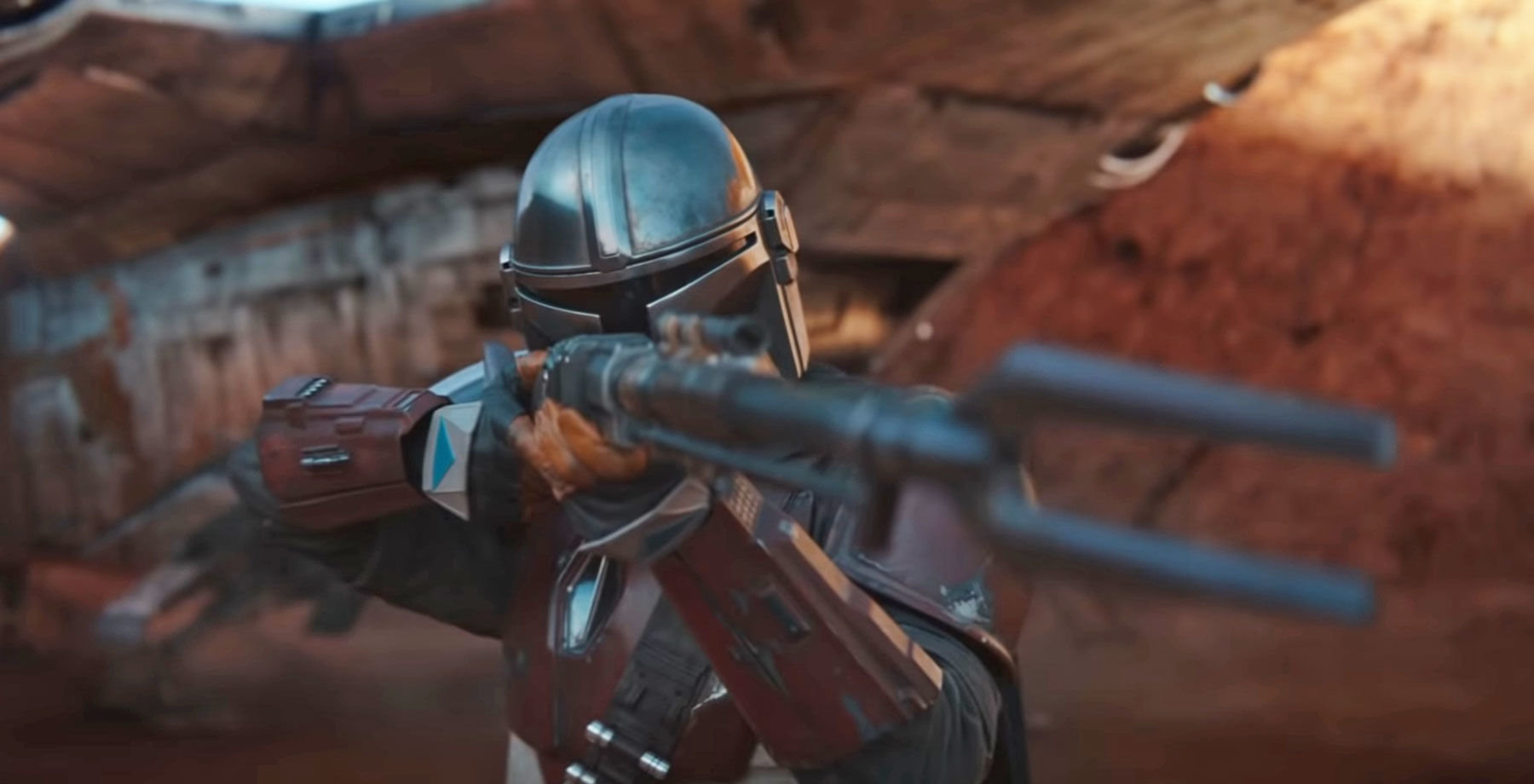
The opening sequence of The Mandalorian brings us face to face with a character who is both new, and yet familiar. Wearing Beskar armor similar to Boba Fett, we see our protagonist standing in the midst of an icy waste land, with a tracking device in hand.

His actions and demeanor don’t disappoint, as we follow the anti-hero on a quest that takes him to unsavory worlds where he meets with people that we don’t trust, and neither does he.

There are dark tones of desperation, and lighter moods of well balanced humor. All of it feels and looks like the Star Wars created by George Lucas.

Indeed, there is a wild west type atmosphere to what we see in The Mandalorian. There are dusty streets occupied by vendors, with the poor living in the shadows. It’s a desperate time for all, and many have chosen to profit from it any way they can. The Mandaloria. is the ultimate gunslinger, and his presence commands everyone’s attention.

dims

I have to say that The Mandalorian has quickly become a personal favorite, simply because it is so authentic and real!

While watching the show I could picture myself living in that kind of environment, on a particular world. I didn’t get that with the sequels.

The only modern entry into the Star Wars franchise that is on level playing field is Rogue One.

The Mandalorian delivers a well thought out story, and features great acting and great cinematography. Most of all, it  takes us back to that era a long time ago, in a galaxy far, far, away where we were all captivated by Star Wars. Perhaps now, we can be captivated once more.


Star Wars Prop Weapons

The weapons used in the Star Wars films are as iconic as the characters that weild them, and often leave us intrigued about their design and origin.

Today I am going to share some of the real world weapons that have served as the basis for many of the props used throughout the Star Wars saga.

The Original Trilogy

Beginning in 1976 with filming of A New Hope, the prop armorers at Pinewood had to develop realistic blasters that reflected an in universe feel to them.

George wanted weapons that appeared real in their form and function, while also being rugged and well worn. For this the armorers turned to surplus weapons stores.

Most of the weapons they selected were from World War One and World War Two, AB’s were British and German in origin.

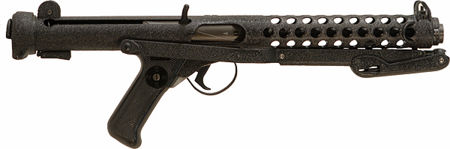
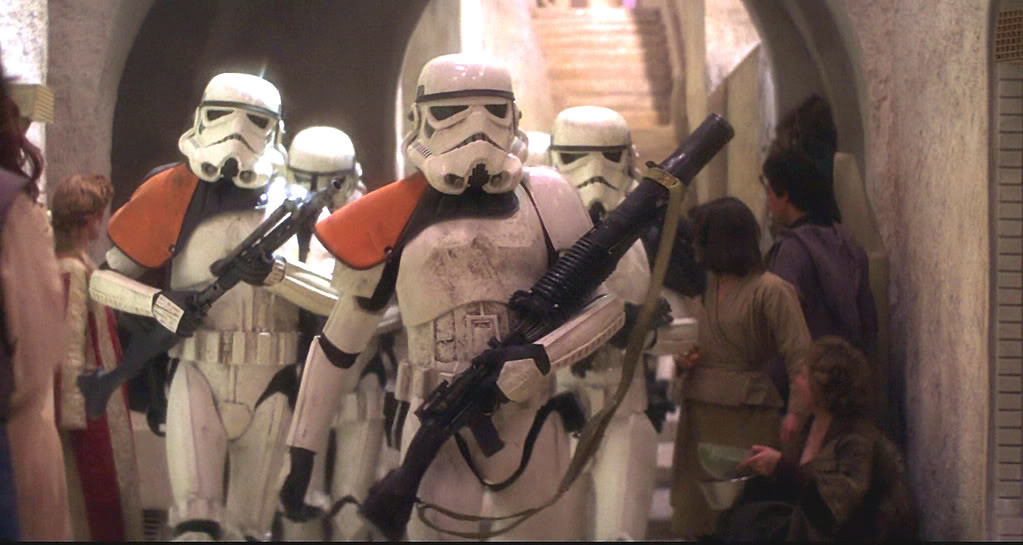
One of the most prominent was the Stormtrooper blaster, which was designed around a British Sterling L2A3 Mark 4 submachine gun. This post- WW2 era weapon was used by the British Military from 1953 until 1994.

The Sterling L2A3

It featured a collapsible and folding stock, as well as a side mounted magazine well to accept a thirty round curved, box magazine.

To make the Imperial Blastech E-11D used by the Stormtroopers, the props department added linear shrouds over the barrel.

They left the stock as is, while adding greeblies to the side of the weapon, and they used WW2 tank scopes for the sights. The thirty round magazines were replaced with short, straight mags For screen use.

For the Rebel Fleet Troopers the armorers made their Blastech DH-17 blasters by utilizing the same Sterling machine gun.

They removed the barrel shroud and replaced it with a shop made prop barrel, and they also removed the folding stock and magazine well.

An extra rod was attracted to the top of the receiver, and a single point scope was added to most versions of the weapon.

Princess Leia’s Drearian Arms Defender sporting blaster was built around a Russian .22 target pistol with a modified barrel.

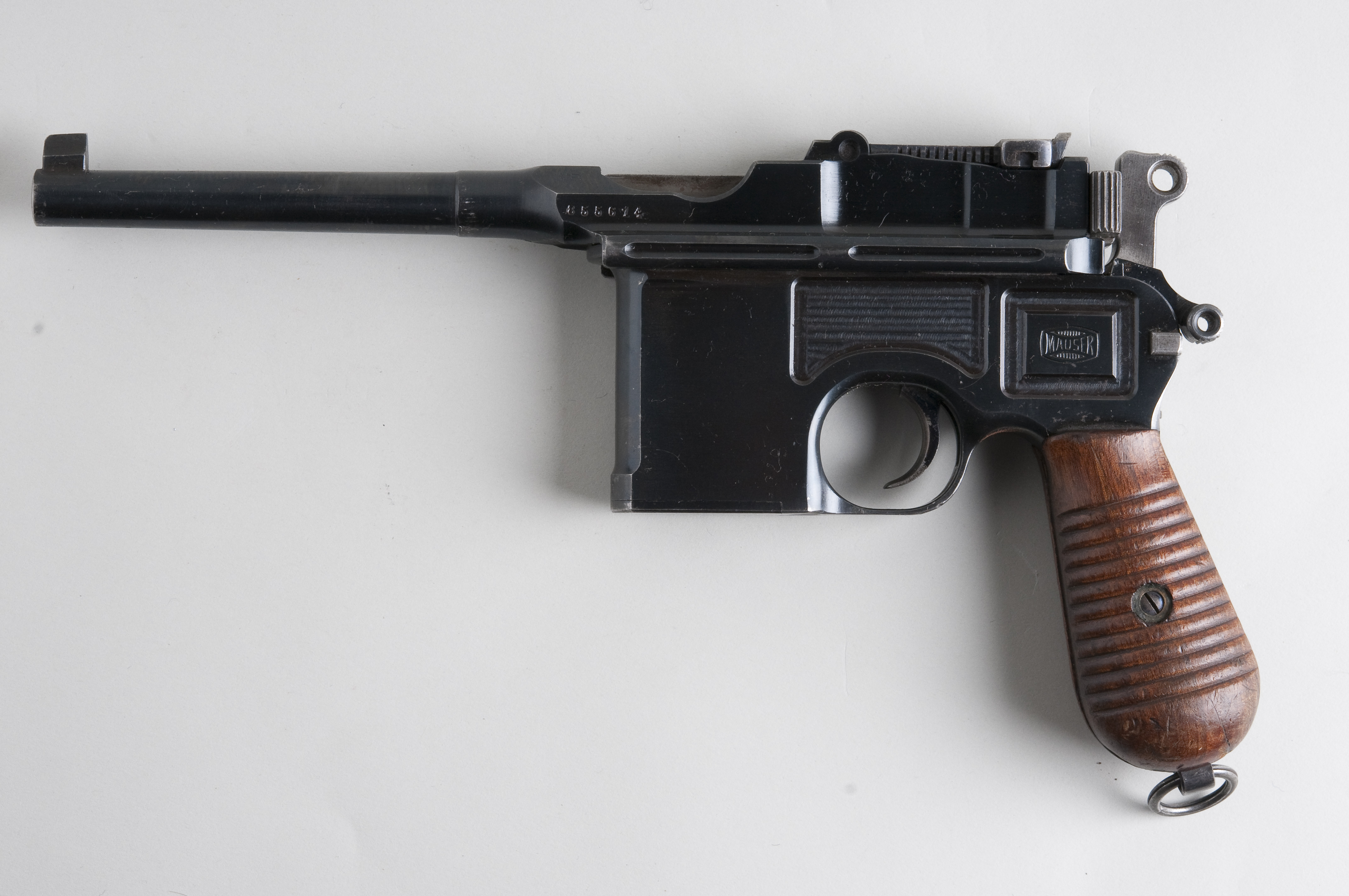
Han Solo’s iconic DL-44 Blaster was based on a WW2 C96 Mauser. It too, featured heavy modifications with a muzzle device, a heat sink in front of the mag well, and a side mounted targeting scope.

This particular prop had three different versions used by Solo in each of the three films. All had slightly different barrels and muzzle devices, and different scopes.

C96 Mauser used for the DL-44 Blaster

Ponda Baba’s blaster was an SE-14c ( Also used as a sidearm by the Death Troopers in Rogue One ) which was made from a Swiss Rexam Favor Mark 5 submachine gun.

The barrel and stock were removed, while an extension was added to the rear of the receiver, as was a scope.

The Stormtroopers patrolling Mos Eisley were all armed with modified MG34s, MG42s, and at least one trooper with a modified Lewis Machine gun.

Stormtrooper carrying a Lewis Machine gun

In The Empire Strikes Back we see the Rebel ground forces carrying Blastech A295 carbines, which are modified versions of the German MP44 machine gun.

Later in Return of the Jedi, the Rebel soldiers are seen carrying the A280, which was made from a cast of the M-16 rifle.

Boba Fett is seen carrying a unique blaster, which actually began as a Webley & Scott No.1 Mark 1 37mm flare gun. The end of the barrel was plugged, and greeblies were added as well as a scope.

Rogue One

In Rogue One, the Rebels primary weapons are again based on the M-16. This includes Cassian Andor’s Blastech A280-CFE, as well as the larger A310 rifles and A300 carbines used by the Rebel Pathfinders.

Jyn Erso’s iconic Blastech A180 blaster is actually a modified Luger 9mm Airsoft pistol. A larger diameter ported barrel has been added, along with greeblies on the bottom and sides of the weapon. Interestingly, Jyn’s blaster is modular, however we never see it configured as a rifle on screen.

Jyn Erso’s A180 Blaster pistol

Functionality

During production of A New Hope and The Empire Strikes Back, most of the weapons fired blanks to assist with visual cues for the actors, as well as aiding the visual effects artists during post-production.

This was not continued during filming of Return of the Jedi. It is however, used again during Rogue One, in the form of airsoft guns.

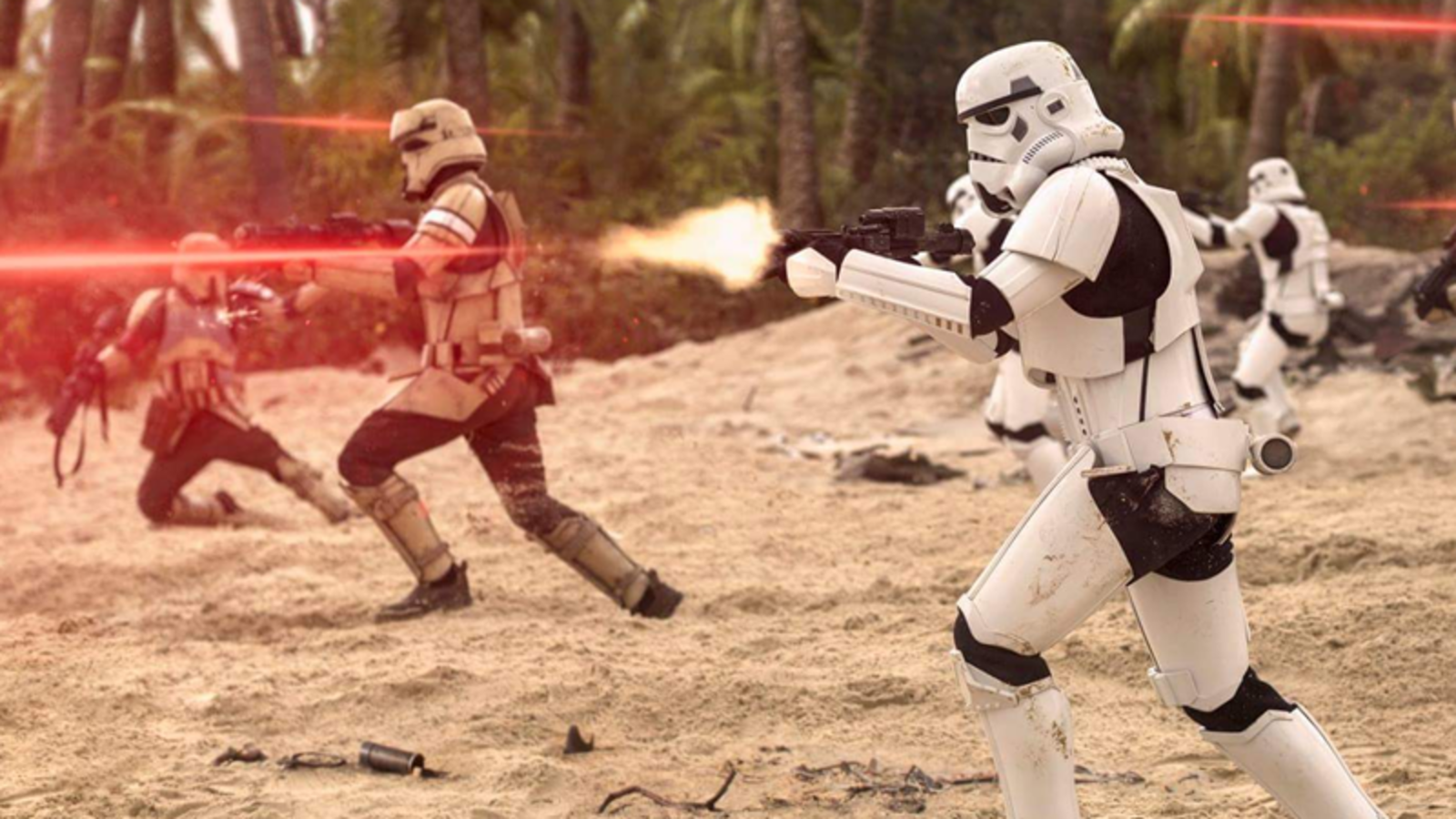
The image below captured during filming shows Jyn Erso firing her A180 blaster pistol at a Stormtrooper.

You can clearly see the gases being vented around the charging handle as the action cycles during firing.

Jyn Erso firing her A180 blaster

Conclusion

These are just a few examples of the real world firearms that have been used by the props department of both Lucasfilm and Pinewood Studios to create the weapons of the Star Wars films.

The armorers took inspiration from the tragedies of warfare, and designed an array of space age blasters that would go down in cinematic history.

Could Tallie Lintra have survived?

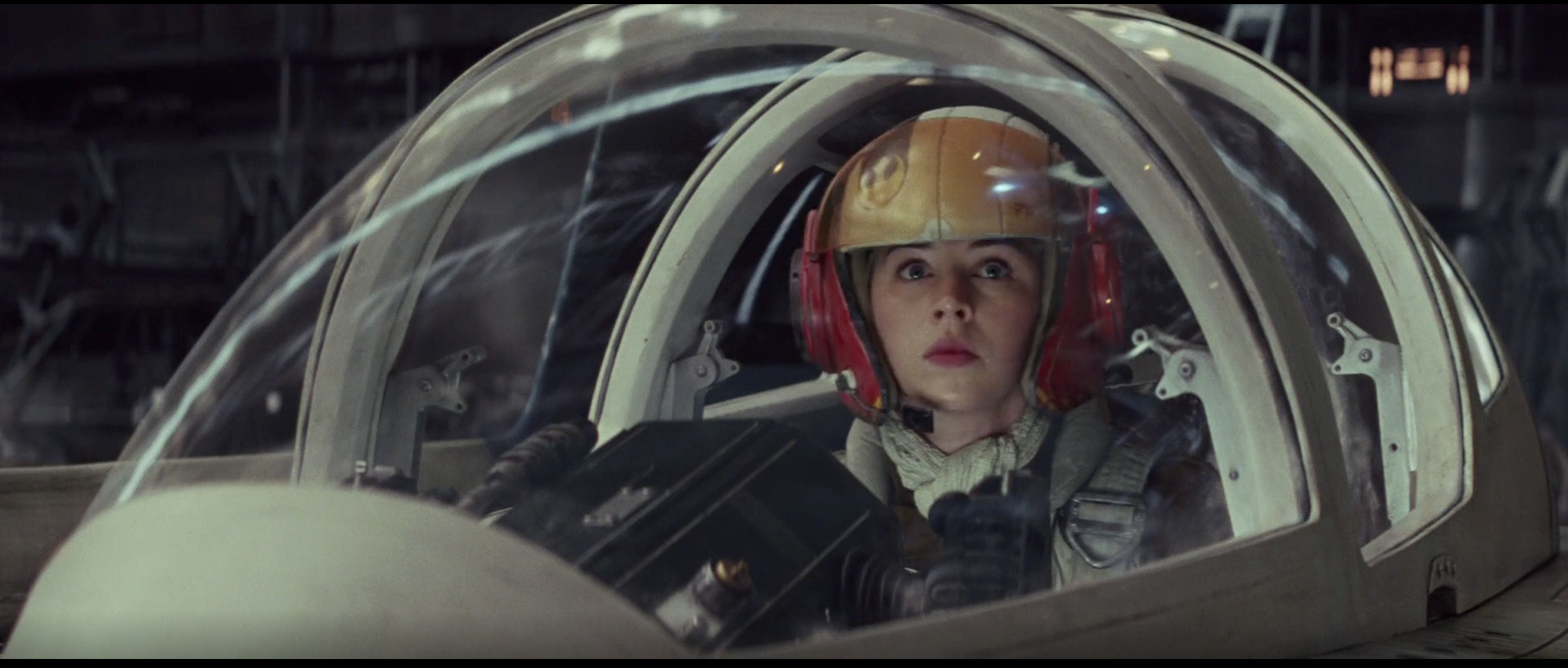
In Star Wars The Last Jedi we are introduced to a young A-Wing pilot with the Resistance, Lieutenant Tallison “Tallie” Lintra.

Tallie is a squadron leader from Pippip three, where she learned to fly from her father, who used an old RZ-1 A-Wing as a crop duster.

Tallie is mature for her age, and a competent leader, but unfortunately she only gets twelve seconds of screen time before she’s seemingly killed.

Yep, that’s right: one of the newest and most fascinating characters of the entire film buys the farm when a concussion missile fired by Kylo Ren detonates inside the hanger bay of the Raddus.

The question is, did she and the other pilots really get killed? To answer that, we need to examine the factors involved with this incident.

First, we will look at the weapon being used, then at the Raddus itself. Finally we will examine Tallie’s A-Wing fighter to determine what if any chance she had to survive.

Concussion Missiles

Starfighters are generally equipped with weapons designed around ship to ship engagements, such as medium or heavy laser cannons.

These weapons are normally supplemented by kinetic energy weapons such as concussion missiles, mag pulse warheads, and proton torpedoes.

The assortment and type of weapons payload depends upon the size and type of fighter, and what role it is designed for.

In The Last Jedi, Kylo Ren is flying a TIE Silencer, which is an updated and more heavily armed variant of it’s predecessor, the TIE Interceptor.

The TIE Silencer was designed to both engage enemy fighters, as well as capital ships. The Silencer is equipped with four Concussion missiles, and Kylo Ren flies into the Raddus‘ amidships area, which protects the hanger bays, before firing two of these missiles.

Kylo Ren firing concussion missiles

We see on screen as both missiles penetrate the magnetic field and detonate inside the hanger bay. The Concussion missile is designed around a solid penetrator they can pierce a ship’s hull, before the warhead itself detonates.

The destruction is caused by the concussion wave from the blast, as it rapidly expands outward in all directions.

The Raddus

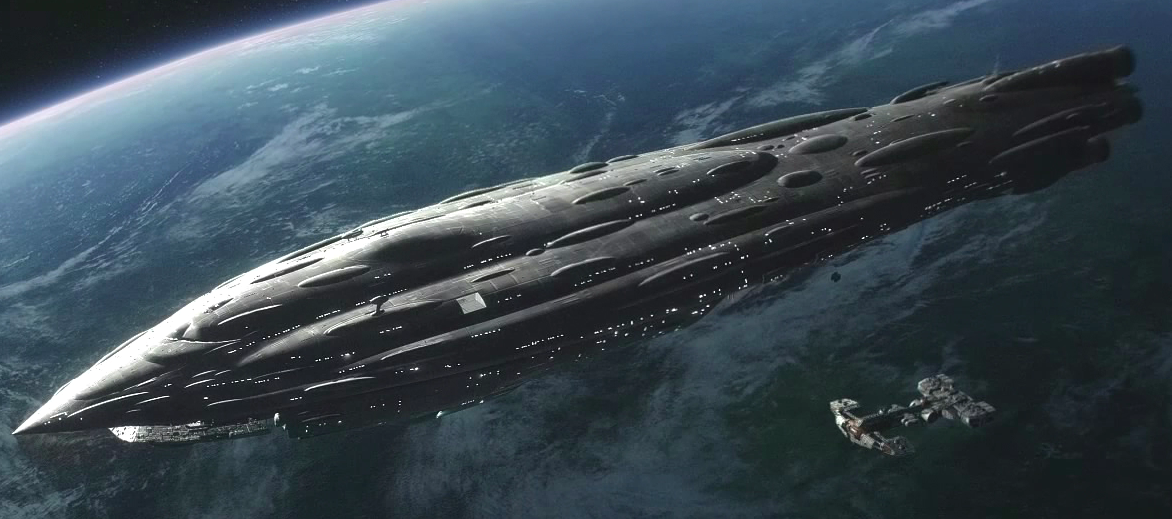
The Raddus was an MC85 Mon Calamari star cruiser, purpose built for the New Republic Defense fleet as a warship.

It was larger than the preceding MC80c class, better shielded, and heavily armed. After it was retired from service during the New Republic draw down, it found it’s way to the Resistance as a gift from the Mon Calamari government.

The Raddus was equipped with a newer, experimental shielding that could withstand heavy bombardment from enemy weapons.

The Raddus

It’s weakness was in the hanger bay. When it was attacked by Kylo Ren, both of his concussion missiles struck the interior bulkhead of the hanger bay before detonating.

The delayed detonation instantly ignited nearby fuel cells and munitions, which in turn destroyed most of the vulnerable fighters on the flight deck.

Had the missiles simply detonated inside the hanger, the resulting blast would not have caused the same amount of damage.

In either case, the blast would have destroyed the magnetic field, opening up the hanger to the vacuum of space, which would have instantaneously extinguished any fires In the bay.

At the same instant the ship’s systems would have detected the pressure and temperature change, instantly sealing the blast doors to the hanger bay.

Detonation inside the hanger

Tallie’s A-Wing

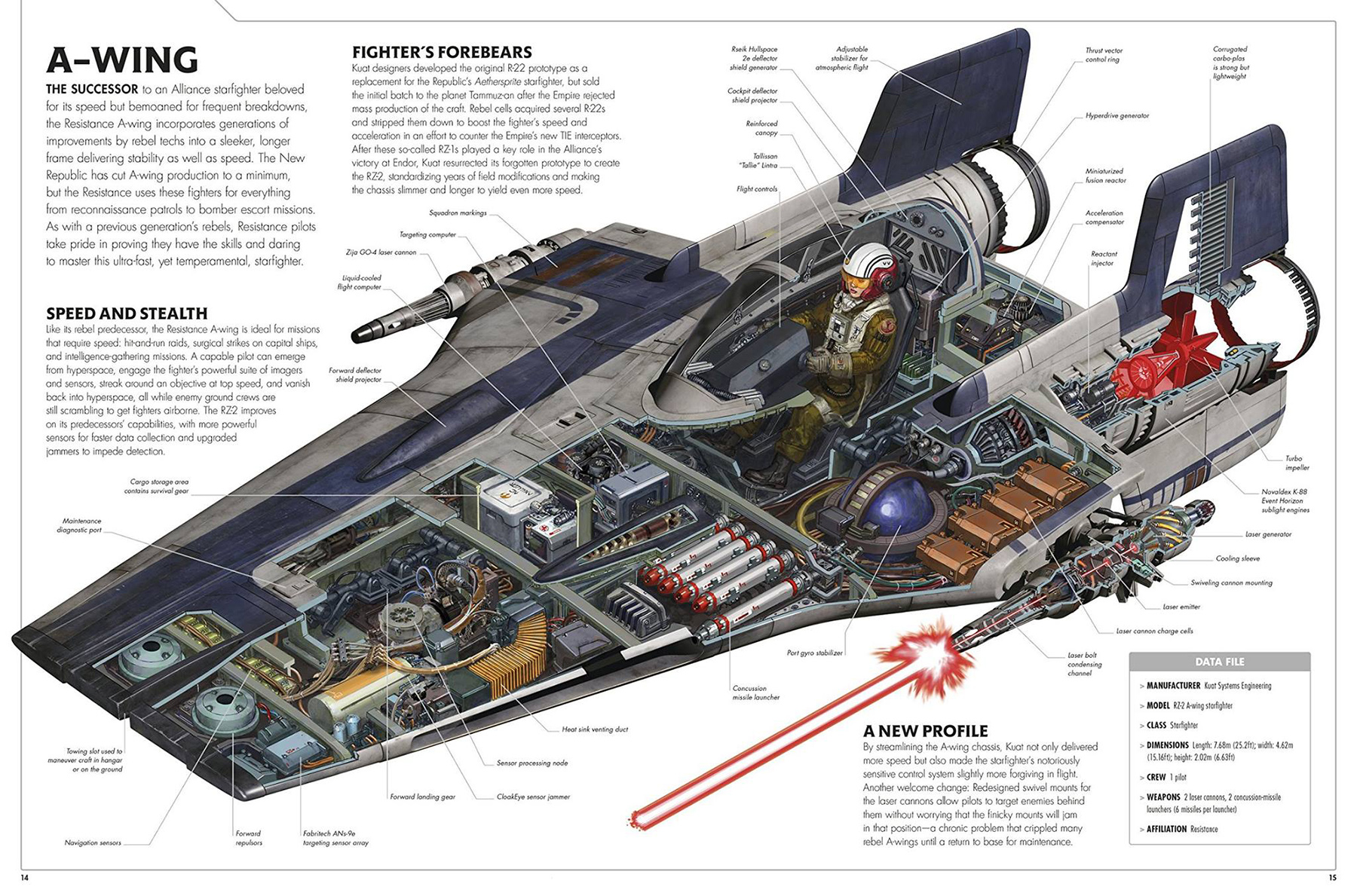
Tallie Lintra was flying the RZ-2 A-Wing Interceptor, the latest evolution of the ship designed by Kuat Systems Engineering.

Among other features, the RZ-2 incorporated a reinforced canopy, and armored hull. The cockpit was also protected by it’s own individual deflector shield generator.

On the flight deck, it’s unlikely that Tallie would have powered up the deflector shields, however she did have her canopy sealed.

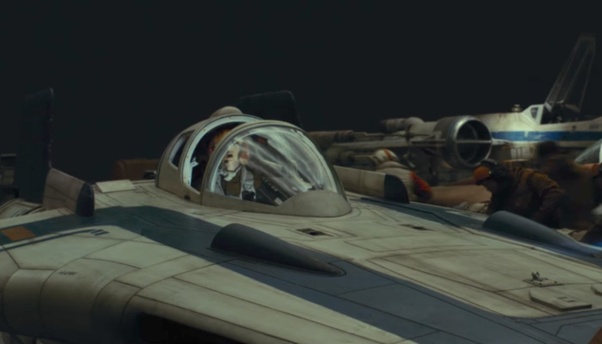
Another advantage was in the positioning of her fighter; it was parked beside Poe’s X-Wing, near the back of the hanger bay.

Tallie’s A-Wing positioned inside the hanger

During the attack scene, we can actually see Tallie’s A-Wing as it is slid across the deck, slamming into the bulkhead before the blast doors automatically sealed.

So what happened to Tallie Lintra? What we aren’t shown on screen is that as soon as those blast doors closed, the hanger bay was exposed to the vacuum of space to extinguish the fire inside of it.

The instantaneous depressurization of the hanger bay would have blown everything inside of it out into open space, including Tallie’s A-Wing.

RZ-2 A-Wing schematic

The most logical conclusion is that Tallie was not killed, merely renderd unconscious from a concussion.

She and her fighter would have drifted out into space along with the other debris. The First Order would not have considered inspecting the debris field, as their objective was to annihilate the Resistance fleet.

As for her fighter, the hull most likely was intact, but not flyable. Presuming that the cockpit remained pressurized, Tallie would have had enough oxygen onboard to survive for roughly thirty six hours before succumbing to oxygen deprivation.

So technically, Tallie could have survived. The question is, did she? If you want to find out, you’ll have to wait for the upcoming novel Rebel Strike to be released. Good luck, and May the Force be with you….