
How the Imperial Navy should have changed the course of the franchise.
As a life long fan of Star Wars, I have always been an admirer of the Extended Universe novels. I thought that the story arc that they presented was a much more grounded continuation of the franchise.
On the flip side of that coin, I loathe the sequel films for their lack of any cohesive plot or story. They were made up as they went along, which resulted in a shameful end to the Skywalker Saga.
By the same token, the Disney Plus live action series have presented their own take on the state of affairs in the galaxy, however they too are lacking one key aspect as well.
By the Numbers
Recently I came across a piece of information that fundamentally changes how either the canon or Legends material should have been structured around the galactic civil war.
There is a discontinued mobile game published by Disney Interactive entitled Star Wars Uprising, which is a canon source.
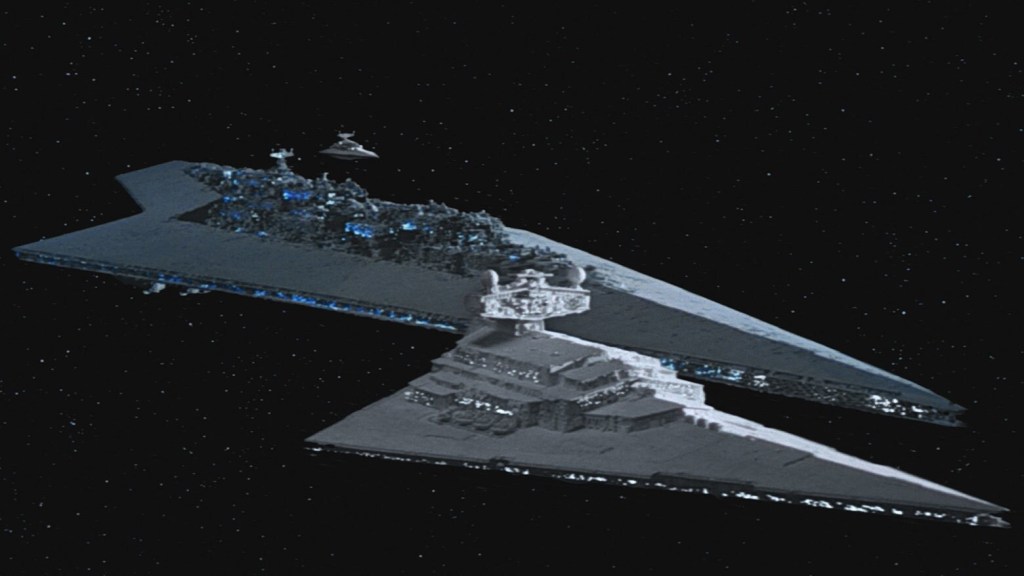
In the game it is stated that at the height of the Age of the Empire, there were approximately 25,000 Star Destroyers in the Imperial fleet.
To put that into perspective, consider this: each Imperial -class Star Destroyer was manned by 9,235 officers, 27,850 non-commissioned officers, and 275 gunners.
That is 37,360 crew members, just to operate the ship. That does not include the compliment of Imperial Army troops, Stormtroopers, or pilots onboard each vessel.
That would bring the total crew compliment for the Star Destroyer fleet to 934,000,000 personnel. This does not include any of the Empire’s other capital or support ships.
This information provides an overwhelming perspective of the disposition and force projection capabilities of the Imperial fleet across the known galaxy.
State of Affairs in the Galaxy
There are 3.2 billion habitable star systems in the Star Wars galaxy (referred to as Sky River), and of those only one billion have sentient life.
Of the one billion star systems, only 69 million meet the population requirements for Imperial representation.
(In the old senate, there were dozens of systems that were represented at the sector level by a single representative speaking on behalf of all of the systems within their sector).
This is integral to the Imperial fleet, because It means in unequivocal terms that both canon and Legends stories would be far from realistic, in regards to the state of affairs in the galaxy.
The war would not have ended at the battle of Endor, and it would not have been the end of the Empire.
Retribution
The Emperor then, would most certainly have created contingency plans for the Grand Moffs to activate in the event of his untimely death.
This idea is played upon in the campaign story of Battlefront II with Operation Cinder, but not to the extent of what it would have been in reality.
Each sector command within the Empire would have immediately marshaled their forces, and gone on high alert at the Emperor’s death.
They would have instituted sector wide lock downs, preventing all space travel into and out of their sectors.
The remaining Moffs would have immediately begun hunting down the Rebel fleet, while the Imperial Security Bureau or ISB, would have begun to assemble target packages for their special operations units.
The Empire would have gone into overdrive in order to quell any uprisings on Imperial controlled or occupied worlds, which were a result of the Alliance victory at Endor.
Civil Affairs and Psychological Operations
Mon Mothma would have capitalized on the moment, and used the Holonet to broadcast a galaxy wide message of the Emperor’s demise, and the establishment of a New Republic.
This form of psychological warfare would have reached far and wide across the galaxy, fueling the fire of rebellion among those oppressed by the Empire.

It would have aided the Rebellion in gaining new allies, and in turn manpower and resources to fight the Empire.
The continued fight for freedom across the galaxy would have only furthered Alliance objectives in re-establishing democracy under the banner of a New Republic.
The long war
The reality is that Alliance and partisan forces could easily overwhelm and defeat Imperial forces on the ground, but not in space.
The Empire would not have conceded to the Rebellion, or collapsed. It would have used the full might of its fleet to engage the Rebel Alliance at every opportunity.
Rebel fleets would have been forced to continue conducting hit and run attacks against the larger more powerful Imperial capital ships, and the shipyards that supported them.
These sorts of skirmishes would have played out across the galaxy, until the Alliance could effectively eliminate the support structure for the Star Destroyers.
Without food, fuel, and weapons, the Empire’s Star Destroyers would be little more than an orbital barracks.
This would be a priority, since the main objective of the Alliance would be to retake Coruscant, the Galactic capital of the Old Republic.
Coruscant rather than Endor would be the defining battle in the war, and would be the symbolic victory needed to rally the galaxy behind the New Republic.
If Coruscant were to fall, then the remnants of the Empire would be forced to withdraw. They would either establish a new capital, or else concede to defeat and disarmament.
Those Moffs who refused would in all likelihood continue to operate as an independent military force, carrying out opportunistic operations in an effort to regroup and regain momentum.
So why is all of this important? Because both canon and Legends material neglect this very fact, so let’s see how they get it wrong:
Legends
This is the simplest of the two narratives to explore, which places the pivotal turning point at the battle of Endor.
Both the destruction of the second Death Star, as well as the death of Emperor Palpatine and Darth Vader leave the Empire without any clear chain of command.
In short order, the Empire falls and acquiesces to the New Republic. This of course is strategically impossible.
The Sequel era
Prior to the sequel films, there is a time period where the New Republic agrees to a military disarmament and draw down.
Their reasoning is to not follow in the footsteps of the Empire, and become a Galactic military force.
In reality, the New Republic would want to do the opposite. They would understand that their best defense against future tyranny, would be a strong offensive capability.
the New Republic would want a unified defense and security force, which it could easily task with deterrent patrols and sector security missions.
Also of note is the battle of Jakku, which in canon is considered the final victory of the Alliance against the Empire.
This too is in error, as Jakku is too remote to be of any strategic importance to the security of the Empire.
Coruscant would be the primary military target of the Rebel Alliance, and only if they succeeded in taking it would they have a chance to oust the Empire from its position of power in the galaxy.
The Realization of War
The Empire would still be a very real threat to the existence of the New Republic for years if not decades, and would serve as the backdrop for every story presented within the franchise.
It would also mean that what we have seen in the live action series and sequel films would not have happened the way that it was portrayed.
Conclusion
So you can see that there is a lot more to be explored in the Star Wars universe than what we have been presented with in either canon or Legends material.
Though some of the writers may have conveniently explained away the Empire in order to accommodate the stories they tell, the reality of war tells a different tale altogether…
 Dark Horizon Creations