
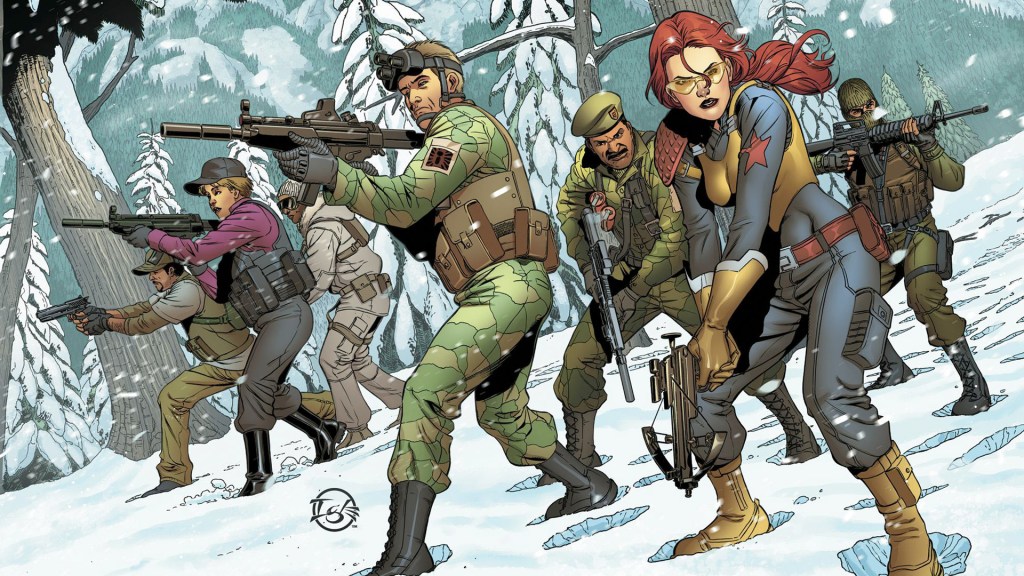
I have been a fan of G.I. Joe for the past thirty-nine years, and tonight I want to discuss a subject that I have never seen anyone address until now, and that is what it would take to become a member of G.I. Joe if they were a real military unit. I am writing this article as a subject matter expert on the franchise, and taking information from the cartoons, comics, live action films, and toy line. I’m also basing it upon my knowledge of the special operations community, having spent the past thirteen years training with retired military special operations personnel.
To begin, we’re all familiar with the tag line that “G.I. Joe is America’s daring and highly trained special missions force.” The key is Special Missions Force, or Unit. If G.I. Joe were real, then it would be classified as a Special Missions Unit, or SMU. These are Tier One Special Operations organizations that conduct classified operations such as Direct Action, Hostage Rescue, Special Reconnaissance, and eliminating High Value Targets, or HVTs.
SMUs recruit candidates from Tier 02 and Tier 03 military units, but are not limited to them for selecting the right candidate. An example of a Tier 02 unit would be the U.S. Army Green Berets (Special Forces, Airborne) while a Tier 03 unit would be the 82nd Airborne Division. Candidates must meet a minimum set of requirements for that specific SMU in order to attend their selection course, and usually requires them to be a certain age, rank, and be able to meet a minimum physical training standard, as well as qualify for a Top-Secret security clearance.
Depending upon the unit, selection will vary, but is most often a month-long course designed to test a candidate’s abilities and commitment. They are looking for individuals who can think for themselves, and outside of the box. They must not only be able to endure physical stress, but they must also demonstrate the mental discipline required to complete selection as well. Candidates are constantly evaluated throughout the selection process by both the cadre’, as well as clinical psychologists who are watching the candidates during selection.
Those who complete selection usually undergo a lengthy psychological evaluation, followed by a six-month long training course specific to that unit. The attrition rates during selection can be greater than ninety percent, and as high as fifty percent during the unit training phase. So now that you have a basic understanding of what a Tier One unit is, and what is required to join, what would that look like for G.I. Joe? Would it be the same, would it be different, or would you be selected right off of the street?
To begin, G.I. Joe is classified as a compartmentalized unit within the United States Army, and does not fall under any conventional chain of command. The Commander would report directly to the Chairman of the Joint Chiefs of Staff (JCS), who in turn would report directly to the National Command Authority (NCA). G.I. Joe would be considered a Tier One unit, because that classification exists to determine the funding of the units within the Special Operations community, more so than it does to identify with their skill levels.
G.I. Joe was in fact inspired and modeled after a real-world Counter -Terrorist Unit, and that would be their primary role. That however, is where the similarities between G.I. Joe and other Tier One units would end. Despite being a U.S. Army unit, G.I. Joe would in reality be a multinational strike force, comprised of candidates from Special Operations units from around the world. These would be the very best of the best men and women in their respective fields of expertise. G.I. Joe itself is an acronym for Global Integrated Joint Operating Entity, and it would be the first and only unit of its kind.
It would require unprecedented diplomatic authority and immunity in order to carry out its mission, and would also become the most secretive unit in any military known to exist. In many ways, G.I. Joe operates and is structured as its own branch of the military, having both the assets, capability, and personnel to deploy anywhere in the world, by air, land, and sea. Where other Special Operations units would be required to coordinate and rely upon other conventional military units for logistical support, G.I. Joe would have no such requirement.
They would operate out of a fixed, permanent base at a classified location in the United States, as well as being forward deployed on their own aircraft carrier, the U.S.S. Flagg (CVNJ-99). In addition, such a unit would be expected to maintain a small operational contingency deployed in strategic locations around the globe. G.I. Joe would maintain and operate their own air and land assets as well, meaning they have the capability to deploy to and operate in any environment, and be there in under eighteen hours of getting an alert. Their unique capabilities set the G.I. Joe team apart from any other unit in existence. As General Hawk stated to Duke in The Rise of Cobra: “when all else fails, we don’t.”
So, who would be qualified to go through the selection process for G.I. Joe, and what would that entail? To begin, G.I. Joe would not limit their candidates to a particular unit or branch of the military. They would select candidates based upon the needs of the unit, and would set similar standards as those in use by current Tier One units around the world. A candidate would have to meet certain requirements such as age, experience, qualifications, and rank. Trust is paramount within the ranks of G.I. Joe, and having the right people is key to their success and survival. I know of at least one civilian (Agent Helix), who was recruited to the G.I. Joe team, and both her existence and identity were kept secret from the rest of the unit.
That would be unprecedented in any other modern unit, in any military that I am aware of, but not within the ranks of G.I. Joe. The needs of the unit would dictate who is selected, and candidates outside of the military may be the exception to the rule, but they would not be excluded. The selection process itself would also be much different, as candidates would not be told the identity of the unit that they are volunteering for. They would be required to sign a Non-Disclosure Agreement, and would undergo an extensive security screening conducted by Counter Intelligence operatives within the G.I. Joe unit, before being accepted to selection.
These highly trained agents would conduct interviews of the candidate’s family, friends, and neighbors, as well as looking at their criminal and financial backgrounds. They would look at every area of their lives, seeking out any reason that the candidates would be disqualified from being trusted to become a unit member. Due to the needs of the unit, team members might also seek out candidates that they have identified through current military records, and attempt to evaluate them through selective and informal exercises and tests, without them being committed to the selection process.
They would do the same for any civilian they may have identified who meets both the physical fitness standards, as well as possessing the skillsets that they are interested in or looking for. Once a candidate was approved for selection, they would receive orders to report for selection, and would be discreetly transported by commercial means to a pre-disclosed location. Upon arrival the candidates would meet up with a cadre’ member who would then escort them to the training site. Unlike other units, G.I. Joe would conceal from the candidates where their training would be conducted, and how long it would last. They would be kept in the dark, and would be briefed on only what they needed to know for operational safety, security, and training purposes.
Each candidate would be evaluated with a preliminary physical fitness test on day one, and upon successful completion of that, they would then continue the selection process. Unlike other SMUs however, selection for G.I. Joe would not be a rehash from their old units. Candidates would be evaluated through continuous evolutions designed to engage their thought process, while under extreme physical duress and stress. The cadre would be looking for individuals with a passive aggressive personality, who could keep their composure while under stress. The candidates would be required to conduct land navigation exercises over mountain terrain, wearing heavy rucks, while under an imposed and unknown time limit.
They would be tested on their ability to problem solve under fire, and conduct missions while rescuing downed team members. The cadre’ would want to know if the candidate meets their standards, and if they have the right attitude and mindset. If the candidates successfully complete the selection process, they would go on to complete a psychological evaluation, and if selected, would then continue their training with the G.I. Joe unit. Like other SMUs, G.I. Joe would conduct a six-month Operator Training Course, divided into training blocks for specific skills. Candidates would receive advanced training to become surgical shooters with small arms and sniper rifles, breaching, and Close Quarters Battle.
They would conduct Combined training exercises putting all of their skills to work, and then move on to more specialized skills training that is specific to the G.I. Joe team. If the candidates successfully completed the Operator Training Course, they would then be assigned to an operational team within the G.I. Joe unit, where they would continue to train when not deployed. So now you know what it would take to become a part of G.I. Joe, America’s top secret and highly trained Special Missions Unit. Next week, we will look at what it takes to become a member of COBRA!
 Dark Horizon Creations