
What happened to G.I. Joe? It’s a question that I’ve found myself asking more than once over the years; particularly since G.I. Joe The Rise of Cobra hit theaters back in 2009.
I’m a big fan of the franchise, having grown up watching the cartoon, and owning most of the original toys from the 3.75 line, as well as some of the Hall of Fame twelve inch figures in the nineties.
G.I. Joe represented the pinnacle of boy’s toys, and was a great moral example to all of America’s youth, finding fans in both it’s intended market, as well as with young girls.
That’s right; G.I. Joe kicked ken’s ass out of the doll house and stole Barbie’s heart from day one, and we’ve never looked back!
All kidding aside, that’s how great G.I. Joe became, and how fun it was to play with them. So what happened to America’s favorite hero?
In all honesty, that depends on who you ask, as well as what their involvement is in the franchise. In this article I’m going to present a brief overview of the history of G.I. Joe, and attempt to answer that question based upon the Intel at hand.
Humble Beginnings
G.I. Joe was originally created in 1963 by a licensing agent in Manhattan named Stan Weston. Mr. Weston actually made the first prototypes of a twelve inch action figure himself.
He eventually showed them to an executive at Hasbro named Donald Levine. Weston subsequently sold the license for G.I. Joe to Hasbro for One hundred thousand dollars.
Whether or not Weston was entitled to a percentage of any of the profits in his contract is unclear, however the success of G.I. Joe is not.
One of the most important decisions made by Hasbro early on involved the marketing of their new product. It was not acceptable to call G.I. Joe a doll, as no parent would buy their son a doll made for boys.
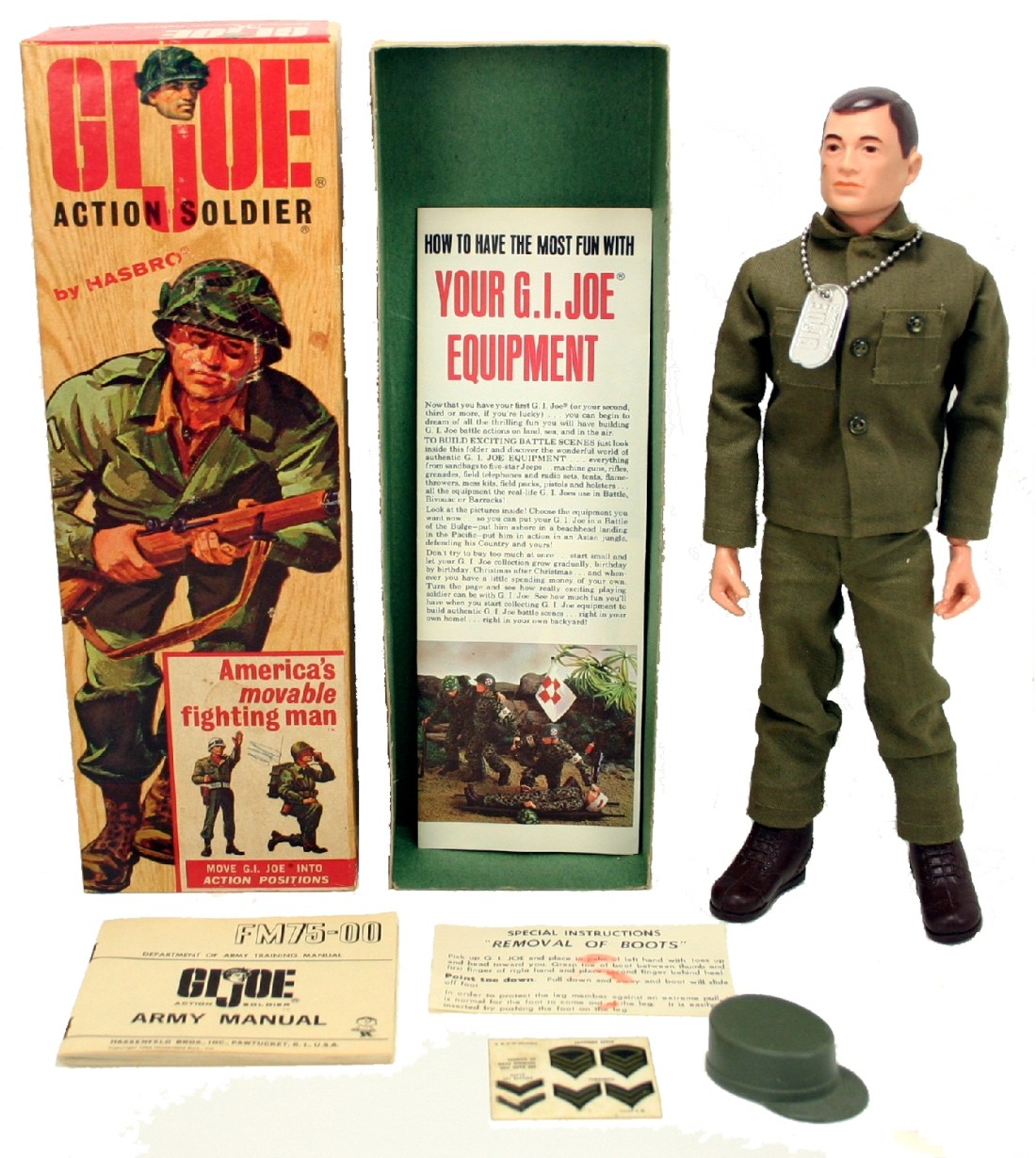
Instead, the term “Action Figure” was used by Hasbro to describe G.I. Joe, and the figures were subsequently marketed with the trademark “America’s movable fighting man” on their packaging.
The first figures hit store shelves in 1964, and featured an Army Soldier, a Marine, a fighter pilot, and a sailor. These figures were produced until 1969.
In 1970 Hasbro made changes to the G.I. Joe line in response to the ongoing negative criticism of the Vietnam war in Southeast Asia.
The line was renamed “Adventure Team”, and departed from military themed service members to provide action and adventure characters from various settings.
Along with the name change Hasbro also incorporated several innovations, including life like hair and beards, as well as a new mold for the figure’s hands dubbed “Kung Fu” grip, allowing them to better grip accessories.
G.I. Joe saw success in other nations as well, due greatly to the figures being licensed by Palitoy Limited, an English toy manufacturer who produced the figures under a license agreement with Hasbro.
The Palitoy figures were released under the title of “ Action Man” from 1966 until 1984, and were distributed in other nations as well by various companies.
A Real American Hero
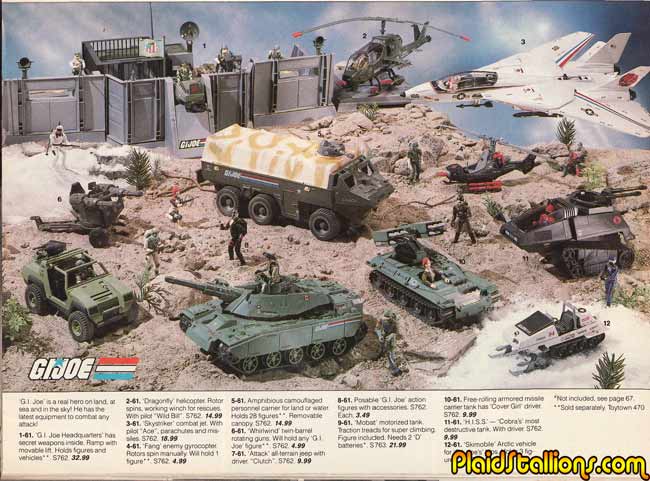
1982 would see the G.I. Joe toy franchise return in a new smaller format of 3.75 inches. These figures were the same scale as the current Star Wars action figures, but with more points of articulation.
Tie-in marketing was pioneered with the G.I. Joe line, as the launch of the new figures was incorporated with the animated cartoon series, as well as an ongoing comic book title.
Ancillary sales were also generated during this time from other merchandise such as lunch boxes, clothing, and role play toys.
Reducing the scale of the figures to 3.75 inches also had the additional benefit of allowing Hasbro to design and produce vehicles and play sets for the figures, and this toy line became the most popular toy lines for boys during it’s run.
It continued throughout the eighties and nineties until it’s cancellation in 1994. Though the primary line for G.I. Joe had come to an end, Hasbro would revive the franchise for various limited assortments that were primarily marketed to collectors.
Each of these sub lines ran for a year to four years, and carried on the G.I. Joe line from 1997 until 2009.
The Rise of Cobra
2009 was a great year for G.I. Joe fans, as we got to see our childhood heroes on the big screen. For the first time ever, the story of G.I. Joe had been turned into a live action movie.
The movie was directed by Stephen Sommers, and opened to audiences on August 07, 2009. It was number one on it’s opening weekend, and It went on to gross three hundred million worldwide, but received a lot of criticism as well as fan backlash.
One of the most agreed upon negative aspects of the film was the actor Marlon Wayans, whose character Ripcord did not resemble the original character, and spent the entire film attempting to flirt with Scarlett.
There were other aspects of the film that detracted from the original G.I. Joe that fans have come to know and love, and the numbers reflect that.
Hasbro released a product line to coincide with the film’s release which was well received for the most part by collectors, and has gone on to nearly triple in value on the secondary market today.

G.I. Joe Retaliation
G.I. Joes next outing at the big screen was more of a soft reboot than a direct sequel, which featured new characters and an absence of the overall science fiction aspect that was prevalent in the first film.
It was a more realistic movie, however it suffered from some very critical mistakes. The first problem to arise was the change in directors. John Chu had never directed an action movie, though he is quoted as being a fan of the franchise.
I think this hurt this film severely, and had the studio brought back Stephen Sommers to direct the sequel, I think that a more successful film franchise would have been established.
The next error maxe by the studios was to push back the opening date from June 2012 to March 2013. The stated reasoning was to convert the film to 3D, however rumors gave a different reason.
Due to the late decision to move the release back, the marketing campaign was in full swing, including with Hasbro.
The toy giant had already shipped product to retailers nationwide, and toys were already on store shelves and being sold when Hasbro issued a recall of the merchandise.
It was finally decided to allow current stock to sell down, and toys were re-shipped again in March 2013. The film opened to mostly negative reviews, which did not sit well for the franchise.

G.I. Joe Snake Eyes
With the failure of two major motion pictures based upon Hasbro’s most successful toy line, you can imagine that fans were left feeling disappointed and frustrated.
To compound that, anytime toy sales don’t meet projected goals, then things get cut, and so it has been with G.I. Joe.
To make matters worse, it seems that studio execs haven’t learned anything from their past mistakes, as a third G.I. Joe movie is set to be released this summer.
This time it’s an origin story of the character Snake Eyes, and rather than abide by the character’s origins as creator Larry Hama had written, the character will now be an Asian male, rather than a Caucasian Army Veteran.
I suspect this decision was made to appeal to the Asian film market, rather than to try and reboot the franchise for the G.I. Joe fan base here in America. Fans here are already upset about the decision, and the film hasn’t even finished production yet!
G.I. Joe versus the cultural and political foes
So why did G.I. Joe quietly disappeared from store shelves, and cease to be the cultural icon and best selling boy’s toy line in America?
First, the original cartoon came to an end in 1989, followed by it’s successor in 1991. Shortly there after in 1994 the G.I. Joe Comic series came to an end, and with it the toy line.
Though there have been at least a dozen separate G.I. Joe sub lines released by Hasbro, none of them saw the success that the originals did, and were mainly purchased by collectors.
From a cultural standpoint, the G.I. Joe brand as a whole saw a decline in interest due in part to a change in what young boys were being presented with.
New cartoons and toys with an emphasis on technology steadily became the norm, until cartoons have all but vanished.
Gone are the daily cartoons in the morning before school, and in the afternoon to keep kids entertained. These were both prime slots for brands like G.I. Joe.
The action figure craze of the eighties has been replaced by cell phones and tablets and video games.
Moreover, there has been a fundamental shift away from the ethics and morality that my generation was raised to abide by.
Boys today are not raised or taught to become strong young men and future leaders; rather they are deprived of the masculinity and sense of manhood that we are inherently born with.
God made us to be men and women, and in today’s society people have abandoned that moral compass in favor of pretending to be something that they are not.
In addition to these factors, we have also seen an increase in military conflicts and violent crimes committed with firearms, which no doubt have caused executives at Hasbro and other companies to question the results of producing military action figures and vehicles bristling with weapons.
That in itself is evidence of the mindset of the culture in which we live. In closing, I would say if anything our young children need a positive role model to look up to, and something to give them a sense of right and wrong that they can relate to.
A renewed G.I. Joe cartoon and toy line would be a great way to do that. It would help them see what I saw growing up: good versus evil, right from wrong.
Choices and the consequences, as well as courage, discipline, honor, integrity, and valor. These are the characteristics that G.I. Joe presented to my generation on a weekly basis, and they could again. Now you know, and knowing is half the battle. Yo Joe!
 Dark Horizon Creations